
|
You entered: emission
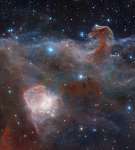 Horsehead: A Wider View
3.05.2013
Combined image data from the massive, ground-based VISTA telescope and the Hubble Space Telescope was used to create this wide perspective of the interstellar landscape surrounding the famous Horsehead Nebula. Captured at near-infrared wavelengths...
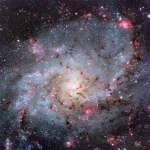 The Hydrogen Clouds of M33
26.12.2013
Gorgeous spiral galaxy M33 seems to have more than its fair share of glowing hydrogen gas. A prominent member of the local group of galaxies, M33 is also known as the Triangulum Galaxy and lies about 3 million light-years distant.
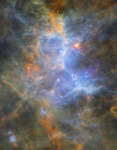 Herschel s Eagle Nebula
28.07.2016
A now famous picture from the Hubble Space Telescope featured Pillars of Creation, star forming columns of cold gas and dust light-years long inside M16, the Eagle Nebula. This false-color composite image views...
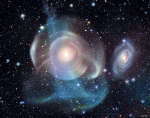 Galaxy NGC 474: Shells and Star Streams
6.02.2018
What's happening to galaxy NGC 474? The multiple layers of emission appear strangely complex and unexpected given the relatively featureless appearance of the elliptical galaxy in less deep images. The cause...
 Sharpless 308: The Dolphin Head Nebula
7.06.2024
Blown by fast winds from a hot, massive star, this cosmic bubble is huge. Cataloged as Sharpless 2-308 it lies some 5,000 light-years away toward the well-trained constellation Canis Major and covers slightly more of the sky than a Full Moon. That corresponds to a diameter of 60 light-years at its estimated distance.
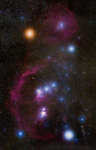 Camera Orion
21.03.2018
Do you recognize this constellation? Although it is one of the most recognizable star groupings on the sky, Orion's icons don't look quite as colorful to the eye as they do to a camera.
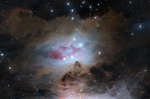 Reflections on the 1970s
2.02.2023
The 1970s are sometimes ignored by astronomers, like this beautiful grouping of reflection nebulae in Orion - NGC 1977, NGC 1975, and NGC 1973 - usually overlooked in favor of the substantial glow from the nearby stellar nursery better known as the Orion Nebula.
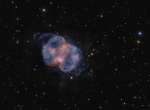 Messier 76
23.07.2010
"Nebula at the right foot of Andromeda ... " begins the description for the 76th object in Charles Messier's 18th century Catalog of Nebulae and Star Clusters. In fact, M76 is one of the fainter objects on the Messier list and is also known by the popular name of the "Little Dumbbell Nebula".
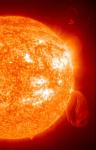 Maximum Sun
1.03.2001
Astronomers recently witnessed an astounding, large scale solar event as the Sun's north and south magnetic poles changed places! But, this complete solar magnetic field flip was actually anticipated. It occurs every 11 years during the maximum of the solar activity cycle.
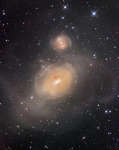 NGC 1316: After Galaxies Collide
2.02.2017
An example of violence on a cosmic scale, enormous elliptical galaxy NGC 1316 lies about 75 million light-years away toward Fornax, the southern constellation of the Furnace. Investigating the startling sight, astronomers suspect the giant galaxy of colliding with smaller neighbor NGC 1317 seen just above, causing far flung loops and shells of stars.
|
January February March April May June July August |
||||||||||||||||||||||||||||||||||||||||||||||||||||||||