
|
Keyword: star
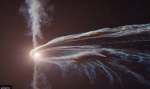 Animation: Black Hole Star Shredder
27.04.2021
What happens if a star gets too close to a black hole? The black hole can rip it apart -- but how? It's not the high gravitational attraction itself that's the problem -- it's the difference in gravitational pull across the star that creates the destruction.
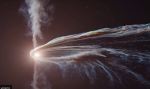 APOD: 2024 June 16 Б Animation: Black Hole Destroys Star
16.06.2024
What happens if a star gets too close to a black hole? The black hole can rip it apart -- but how? It's not the high gravitational attraction itself that's the problem -- it's the difference in gravitational pull across the star that creates the destruction.
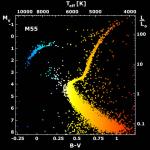 M55 Color Magnitude Diagram
23.02.2001
This color "picture" of globular star cluster M55 may not look like any star cluster you've ever seen. Still, it shows a most fundamental view for students of stellar astronomy. In the picture...
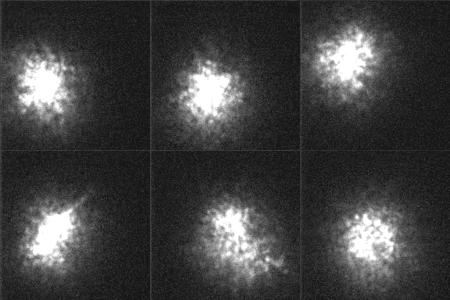 Why Stars Twinkle
25.07.2000
This is what a star really looks like from the surface of the Earth. To the best the human eye can see, stars are so far away they appear the same as would infinitesimal points of light.
 The 25 Brightest Stars in the Night Sky
18.12.2022
Do you know the names of some of the brightest stars? It's likely that you do, even though some bright stars have names so old they date back to near the beginning of written language.
 Small Star
5.06.1997
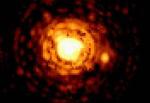
A dim double star system cataloged as Gliese 623 lies 25 light-years from Earth, in the constellation of Hercules. The individual stars of this binary system were distinguished for the first time when the Hubble Space Telescope's Faint Object Camera recorded this image in June 1994.
 Neutron Star Earth
16.06.1995
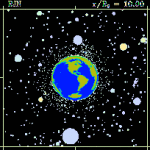
If the Earth could somehow be transformed to the ultra-high density of a neutron star , it might appear as it does in the above computer generated figure. Due to the very strong gravitational field, the neutron star distorts light from the background sky greatly. If you look closely, two
 The Pleiades Star Cluster
25.10.1998
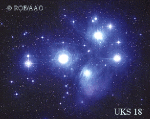
It is the most famous star cluster on the sky. The Pleiades can be seen without binoculars from even the depths of a light-polluted city. Also known as the Seven Sisters and M45, the Pleiades is one of the brightest and closest open clusters.
 Star Size Comparison 2
12.06.2018
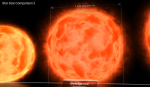
How big is our Sun compared to other stars? In dramatic and popular videos featured on YouTube, the relative sizes of planets, stars, and even the universe are shown from smallest to largest. The featured video begins with Earth's Moon and progresses through increasingly larger moons and planets in our Solar System.
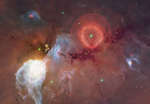 Massive Shell Expelling Star G79 29 0 46
25.09.2017
Stars this volatile are quite rare. Captured in the midst of dust clouds and visible to the right and above center is massive G79.29+0.46, one of less than 100 luminous blue variable stars (LBVs) currently known in our Galaxy.
|
January February March April May June July August September October |
|||||||||||||||||||||||||||||||||||||||||||||||||