
|
Keyword: NGC 6888
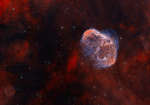 Cygnus: Bubble and Crescent
17.10.2020
These clouds of gas and dust drift through rich star fields along the plane of our Milky Way Galaxy toward the high flying constellation Cygnus. Caught within the telescopic field of view are the Soap Bubble (lower left) and the Crescent Nebula (upper right).
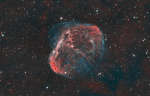 NGC 6888: The Crescent Nebula
17.06.2021
NGC 6888, also known as the Crescent Nebula, is a about 25 light-years across blown by winds from its central, bright, massive star. A triumvirate of astroimagers ( Joe, Glenn, Russell) created this sharp portrait of the cosmic bubble.
 APOD: 2024 November 12 Б NGC 6888: The Crescent Nebula
12.11.2024
How was the Crescent Nebula created? Looking like an emerging space cocoon, the Crescent Nebula, visible in the center of the featured image, was created by the brightest star in its center. A leading progenitor hypothesis has the Crescent Nebula beginning to form about 250,000 years ago.
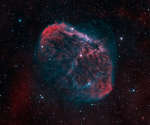 NGC 6888: The Crescent Nebula
10.06.2016
NGC 6888, also known as the Crescent Nebula, is a cosmic bubble about 25 light-years across, blown by winds from its central, bright, massive star. This sharp telescopic portrait uses narrow band image data that isolates light from hydrogen and oxygen atoms in the wind-blown nebula.
 NGC 6888: The Crescent Nebula
28.11.2025
NGC 6888, also known as the Crescent Nebula, is a about 25 light-years across, a cosmic bubble blown by winds from its central, massive star. This deep telescopic image includes narrowband image data, to isolate light from hydrogen and oxygen atoms.
 APOD: 2023 September 4 Б Cygnus: Bubble and Crescent
4.09.2023
As stars die, they create clouds. Two stellar death clouds of gas and dust can be found toward the high-flying constellation of the Swan (Cygnus) as they drift through rich star fields in the plane of our Milky Way Galaxy.
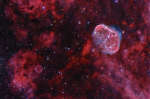 Cygnus: Bubble and Crescent
4.12.2015
These clouds of gas and dust drift through rich star fields along the plane of our Milky Way Galaxy toward the high flying constellation Cygnus. Caught within the telescopic field of view are the Soap Bubble (lower left) and the Crescent Nebula (upper right).
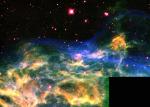 At the Edge of the Crescent Nebula
2.08.2000
The Crescent Nebula is a rapidly expanding shell of gas surrounding a dying star. In this recently released image by the Hubble Space Telescope, a bright dynamic part of the nebula three light-years across is shown in representative color.
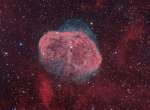 NGC 6888: The Crescent Nebula
13.08.2008
NGC 6888, also known as the Crescent Nebula, is a cosmic bubble about 25 light-years across, blown by winds from its central, bright, massive star. This beautiful telescopic view combines a composite color image with narrow band data that isolates light from hydrogen and oxygen atoms in the wind-blown nebula.
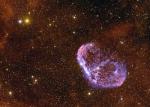 A Crescent Nebula Star Field
15.04.2003
What caused the Crescent Nebula? Looking like an emerging space cocoon, the Crescent Nebula, visible on the right, was created by the brightest star in its center. A leading progenitor hypothesis has the Crescent Nebula beginning to form about 250,000 years ago.
|
January February March April May June July |
|||||||||||||||||||||||||||||||||||||||||||||||||