
|

Credit & Copyright: Zhuoqun Wu,
Chilescope Telescope 2
Explanation:
Is there a waterfall in Orion?
No, but some of the dust in M43 appears similar to a
waterfall on Earth.
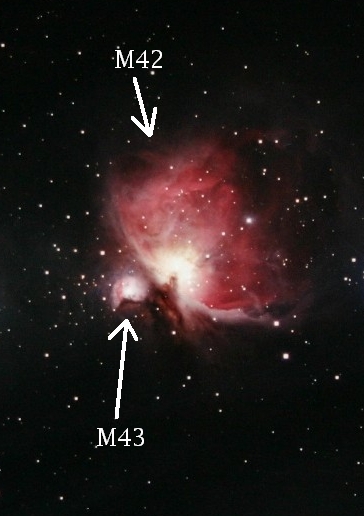
M43, part of the
Orion Molecular Cloud
Complex, is the often imaged but rarely mentioned neighbor
of the more famous M42.
M42, which includes many bright stars from the
Trapezium cluster, lies above the featured scene.
M43
is itself a star forming region and although laced with filaments of dark dust,
is composed mostly of glowing
hydrogen.
The entire
Orion field, located about 1600
light years away, is inundated with many intricate and
picturesque
filaments of dust.
Opaque to visible light, dark
dust is
created in the outer atmosphere of massive cool stars and expelled by a strong
outer wind of
protons and
electrons.
Free Download:
2019 APOD Calendar (v4 with light background)
|
January February March April May June July August September October November December |
| |||||||||||||||||||||||||||||||||||||||||||||||||||||||
NASA Web Site Statements, Warnings, and Disclaimers
NASA Official: Jay Norris. Specific rights apply.
A service of: LHEA at NASA / GSFC
& Michigan Tech. U.
Based on Astronomy Picture
Of the Day
Publications with keywords: M 43 - Orion - dust
Publications with words: M 43 - Orion - dust
See also:
- APOD: 2026 July 22 Б The Corona Australis Cloud and the Chandelier Cluster
- APOD: 2026 July 9 Б The Red Glow of the Cosmic Bat Nebula
- APOD: 2026 May 5 Б Orion over Mount Teide
- APOD: 2026 March 2 Б The Dusty Surroundings of Orion and the Pleiades
- APOD: 2026 February 18 Б Orions Cradle
- APOD: 2026 February 2 Б Orion: The Running Man Nebula
- APOD: 2026 January 28 Б M78: Reflecting Blue in a Sea of Red