
|
You entered: nearest stars
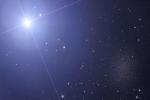 Bright Star Regulus near the Leo 1 Dwarf Galaxy
19.06.2006
The star on the upper left is so bright it is sometimes hard to notice the galaxy on the lower right. Both the star, Regulus, and the galaxy, Leo I, can be found within one degree of each other toward the constellation of Leo.
 The Nearest Stars
18.03.2001
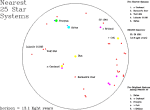
Which stars are closest to the Sun? The closest is Proxima Centauri, one of three stars that orbit each other about 4 light-years away in the Alpha-Centauri system. Alpha Centauri is easily visible from Earth's
 The Nearest Stars
21.04.1999
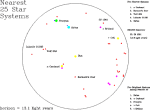
Which stars are closest to the Sun? The closest is Proxima Centauri, one of three stars that orbit each other about 4 light-years away in the Alpha-Centauri system. Alpha Centauri is easily visible from Earth's Southern Hemisphere. Next is Barnard's Star, a dim star visible with a telescope in the constellation of Ophiuchus.
 Sgr A: Fast Stars Near the Galactic Center
20.12.2000
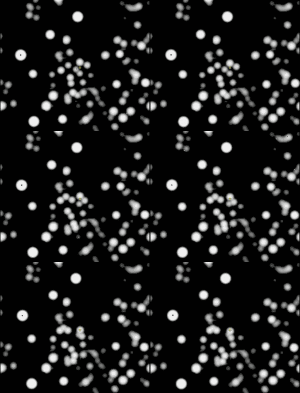
Why are these stars moving so fast? Shown above is a time-lapse movie in infrared light detailing how stars in the central light-year of our Galaxy have moved over the past eight years. The yellow mark at the image center represents the location of a peculiar radio source named Sgr A
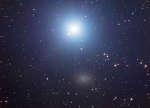 Bright Star Regulus near the Leo I Dwarf Galaxy
10.01.2012
The star near the top is so bright that it is sometimes hard to notice the galaxy toward the bottom. Pictured above, both the star, Regulus, and the galaxy, Leo I, can be found within one degree of each other toward the constellation of the Lion (Leo).
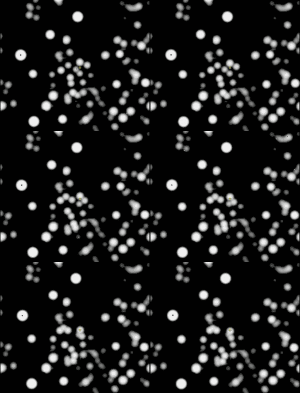 Sgr A*: Fast Stars Near the Galactic Center
14.01.2007
Why are these stars moving so fast? Shown above is a time-lapse movie in infrared light detailing how stars in the central light-year of our Galaxy have moved over the past eight years.
 APOD: 2024 June 11 Б Colorful Stars and Clouds near Rho Ophiuchi
11.06.2024
Why is the sky near Antares and Rho Ophiuchi so colorful, yet dusty? The colors result from a mixture of objects and processes. Fine dust -- illuminated by starlight -- produces blue reflection nebulae. Gaseous clouds whose atoms are excited by ultraviolet starlight produce reddish emission nebulae. Backlit dust clouds block starlight and so appear dark.
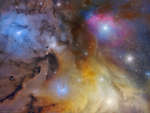 Stars, Dust, and Gas Near Antares
26.01.2022
Why is the sky near Antares and Rho Ophiuchi so dusty yet colorful? The colors result from a mixture of objects and processes. Fine dust -- illuminated from the front by starlight -- produces blue reflection nebulae. Gaseous clouds whose atoms are excited by ultraviolet starlight produce reddish emission nebulae.
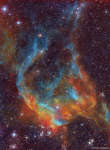 Stars, Dust, and Gas near NGC 3572
28.05.2019
Star formation can be colorful. This chromatic cosmic portrait features glowing gas and dark dust near some recently formed stars of NGC 3572, a little-studied star cluster near the Carina Nebula. Stars from...
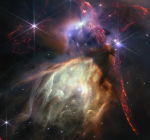 Webb's Rho Ophiuchi
25.10.2025
A mere 390 light-years away, Sun-like stars and future planetary systems are forming in the Rho Ophiuchi molecular cloud complex, the closest star-forming region to our fair planet. The James Webb Space Telescope's NIRCam peered into the nearby natal chaos to capture this infrared image at an inspiring scale.
|
January February March April May June July August September October |
|||||||||||||||||||||||||||||||||||||||||||||||||