
|
You entered: little dipper
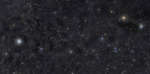 The Little Dipper
14.05.2011
At 2nd magnitude, Polaris is far from the brightest star in the night sky. But it is the brightest star at the left of this well-composed, starry mosaic spanning about 23 degrees across the northern sky asterism dubbed the Little Dipper.
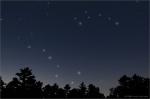 The Big Dipper
8.01.2007
Do you see it? This common question frequently precedes the rediscovery of one of the most commonly recognized configurations of stars on the northern sky: the Big Dipper. This grouping of stars is one of the few things that has likely been seen, and will be seen, by every generation.
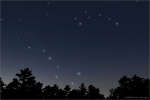 The Big Dipper
21.04.2013
Do you see it? This common question frequently precedes the rediscovery of one of the most commonly recognized configurations of stars on the northern sky: the Big Dipper. This grouping of stars is one of the few things that has likely been seen, and will be seen, by every generation.
 A Spring Sky Over Hirsau Abbey
6.05.2009
What's in the sky tonight? When strolling outside just after sunset, even if just going out to your car, a casual glance upwards can reveal a beautiful night sky also seen by many people across the Earth.
 Big Dipper Above and Below Chilean Volcanoes
9.05.2017
Do you see it? This common question frequently precedes the rediscovery of one of the most commonly recognized configurations of stars on the northern sky: the Big Dipper. This grouping of stars is one of the few things that has likely been seen, and will be seen, by every generation.
 Polaris: The North Star
6.10.1999
Polaris is quite an unusual star. First, Polaris is the nearest bright star to the north spin axis of the Earth. Therefore, as the Earth turns, stars appear to rotate around Polaris, making it the North Star.
 APOD: 2023 February 7 Б A Comet and Two Dippers
7.02.2023
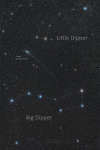
Can you still see the comet? Yes. Even as C/2022 E3 (ZTF) fades, there is still time to see it if you know where and when to look. Geometrically, Comet ZTF has passed its closest to both the Sun and the Earth and is now headed back to the outer Solar System.
 Hyakutake: Stars Through A Comet Tail
17.07.1998
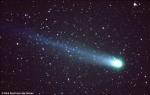
Comets are cosmic icebergs. They follow very elongated orbits which carry them from the frozen, remote outer reaches of the Solar System to close encounters with the Sun. Heated by sunlight, they slough off layers of material as gas and dust, forming their characteristic awe-inspiring comas (heads) and tails.
 Aurora In West Texas Skies
15.09.2000
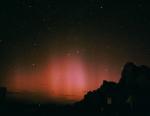
The aurora borealis, or northern lights, are not a common sight in the southwestern United States. But a strong solar coronal mass ejection in early August triggered geomagnetic storms and aurora which were widely reported, even under west Texas skies.
 Comet Hyakutake Passes the Earth
16.12.2009
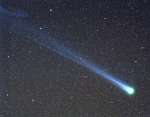
In 1996, an unexpectedly bright comet passed by planet Earth. Discovered less than two months before, Comet C/1996 B2 Hyakutake came within only 1/10th of the Earth-Sun distance from the Earth in late March.
|
January February March April May June July August September |
|||||||||||||||||||||||||||||||||||||||||||||||||