
|
You entered: Tycho
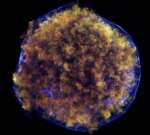 Tycho s Supernova Remnant
30.04.2011
Tycho! Tycho! burning bright In the darkness of the night, What exploding white dwarf star Did frame thy remnant from afar, In the distant deep dark skies Under gaze of human eyes? Seen by mortals and their ma Named for one called Tycho Brahe.
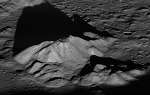 Sunrise at Tycho
6.07.2011
Tycho crater's central peak complex casts a long, dark shadow near local sunrise in this spectacular lunarscape. The dramatic oblique view was recorded on June 10 by the Lunar Reconnaissance Orbiter. Shown in amazing detail, boulder strewn slopes and jagged shadows appear in the highest resolution version at 1.5 meters per pixel.
 Sunrise at Tycho
4.01.2013
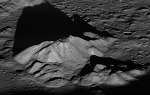
Tycho crater's central peak complex casts a long, dark shadow near local sunrise in this spectacular lunarscape. The dramatic oblique view was recorded on June 10, 2011 by the Lunar Reconnaissance Orbiter. Shown in amazing detail, boulder strewn slopes and jagged shadows appear in the highest resolution version at 1.5 meters per pixel.
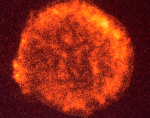 Tychos Supernova Remnant in X ray
7.03.1999
How often do stars explode? By looking at external galaxies, astronomers can guess that these events, known as a supernovae, should occur about once every 30 years in a typical spiral galaxy like our MilkyWay.
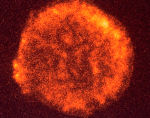 Tycho's Supernova Remnant in X-ray
23.06.1996
How often do stars explode? By looking at external galaxies, astronomers can guess that these events, known as a supernovae, should occur about once every 30 years in a typical spiral galaxy like our MilkyWay.
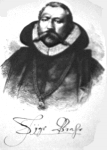 Tycho Brahe Measures the Sky
30.05.1999
Tycho Brahe was the most meticulous astronomical observer of his time. Brahe, who lived between 1546 and 1601, set out to solve the day's most pressing astronomical problem: to determine whether the Earth or the Sun was at the center of the Solar System.
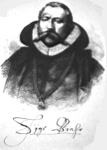 Tycho Brahe Measures the Sky
15.09.1996
Tycho Brahe was the most meticulous astronomical observer of his time. Brahe, who lived between 1546 and 1601, set out to solve the day's most pressing astronomical problem: to determine whether the Earth or the Sun was at the center of the Solar System.
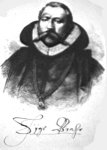 Tycho Brahe Measures the Sky
7.01.2001
Tycho Brahe was the most meticulous astronomical observer of his time. Brahe, who lived between 1546 and 1601, set out to solve the day's most pressing astronomical problem: to determine whether the Earth or the Sun was at the center of the Solar System.
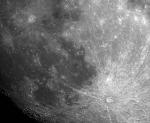 Tycho and Copernicus: Lunar Ray Craters
5.03.2005
Dazzling in binoculars or a small telescope, the Moon is pocked with impact craters. During partial lunar phases, the craters along the terminator are cast in dramatic relief by strong shadows. But when the Moon is full some craters seem to sprout systems of bright radial lines or rays.
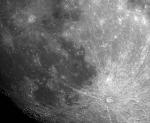 Tycho and Copernicus: Lunar Ray Craters
9.08.2001
Dazzling in binoculars or a small telescope, the Moon is pocked with impact craters. During partial lunar phases, the craters along the terminator are cast in dramatic relief by strong shadows. But when the Moon is full some craters seem to sprout systems of bright radial lines or rays.
|
January February March April May June July August |
||||||||||||||||||||||||||||||||||||||||||||||||||||||||