
|
You entered: massive stars
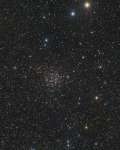 NGC 7789: Caroline s Rose
26.10.2013
Found among the rich starfields of the Milky Way toward the constellation Cassiopeia, star cluster NGC 7789 lies about 8,000 light-years away. A late 18th century deep sky discovery of astronomer Caroline Lucretia Herschel, the cluster is also known as Caroline's Rose.
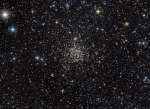 NGC 7789: Caroline's Rose
15.11.2017
Found among the rich starfields of the Milky Way, star cluster NGC 7789 lies about 8,000 light-years away toward the constellation Cassiopeia. A late 18th century deep sky discovery of astronomer Caroline Lucretia Herschel, the cluster is also known as Caroline's Rose.
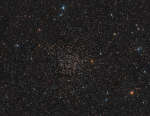 NGC 7789: Caroline s Rose
6.07.2024
Found among the rich starfields of the Milky Way, star cluster NGC 7789 lies about 8,000 light-years away toward the constellation Cassiopeia. A late 18th century deep sky discovery of astronomer Caroline Lucretia Herschel, the cluster is also known as Caroline's Rose.
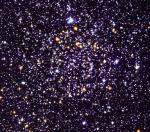 NGC 7789: Galactic Star Cluster
9.07.1999
At 1.6 billion years old, this cluster of stars is beginning to show its age. NGC 7789 is an open or galactic star cluster about 8,000 light-years distant toward the constellation Cassiopeia and lies near the plane of our Milky Way galaxy.
 The Coldest Brown Dwarf
30.08.2011
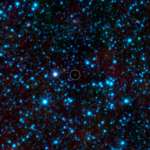
This cosmic snapshot composed with image data from NASA's Wide-field Infrared Survey Explorer (WISE) satellite captures a multitude of faint stars and distant galaxies toward the constellation Lyra at wavelengths longer than visible light. But the object circled at the center is not quite a star.
 Mount Etna Milky Way
5.07.2024
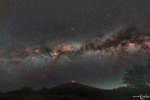
A glow from the summit of Mount Etna, famous active stratovolcano of planet Earth, stands out along the horizon in this mountain and night skyscape. Bands of diffuse light from congeries of innumerable stars along the Milky Way galaxy stretch across the sky above.
 Methane Dwarf
3.06.1999
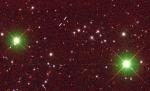
While hunting through Sloan Sky Survey data in search of distant quasars, Princeton astronomers Xiaohui Fan and Michael Strauss came upon an undiscovered type of object very nearby - now dubbed a methane dwarf. Marked...
 M31 versus M33
26.09.2015
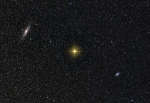
Separated by about 14 degrees (28 Full Moons) in planet Earth's sky, spiral galaxies M31 at left, and M33 are both large members of the Local Group, along with our own Milky Way galaxy.
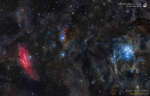 From California to the Pleiades
22.11.2013
An astronomical trip from the California Nebula to the Pleiades star cluster would cover just 12 degrees across planet Earth's night sky. That's equivalent to the angular extent of 25 Full Moons, as your telescope sweeps over the borders of the constellations Perseus and Taurus.
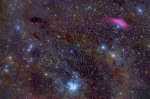 Comet PanSTARRS is near the Edge
16.02.2018
The comet PanSTARRS, also known as the blue comet (C/2016 R2), really is near the lower left edge of this stunning, wide field view recorded on January 13. Spanning nearly 20 degrees on the sky, the cosmic landscape is explored by well-exposed and processed frames from a sensitive digital camera.
|
January February March April May June July August September |
|||||||||||||||||||||||||||||||||||||||||||||||||