
|
You entered: apod
 Horizon to Horizon
21.12.2007
Scroll right and journey from horizon to horizon as your gaze sweeps through the zenith in the night sky over Beg-Meil, France. Recorded on December 13th, the entertaining panorama (image key) covers 210 degrees in 21 separate exposures, beginning on the beach with bright star Sirius rising in the southeast.
 To Fly Free in Space
1.01.2012
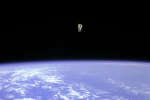
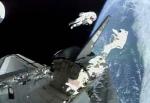
At about 100 meters from the cargo bay of the space shuttle Challenger, Bruce McCandless II was farther out than anyone had ever been before. Guided by a Manned Maneuvering Unit (MMU), astronaut McCandless, pictured above, was floating free in space.
 Aurora and Fireball Over Norway
5.10.2012
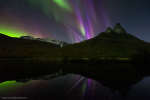
What's happening behind that mountain? A convergence of variable sky spectacles. One night in mid-September near TromsЬ, Norway, high red aurora could be seen shimmering through lower green aurora in a way that created a striking and somewhat unusual violet glow.
 Star Cluster R136 Bursts Out
29.07.2012
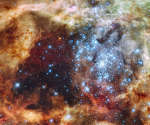
In the center of star-forming region 30 Doradus lies a huge cluster of the largest, hottest, most massive stars known. These stars, known collectively as star cluster R136, were captured above in visible light by the newly installed Wide Field Camera peering though the recently refurbished Hubble Space Telescope.
 Prometheus and the Rings of Saturn
17.12.2004
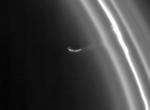
In Greek Mythology, Prometheus was known for stealing fire from the gods. Ironically, in a story for more modern times Prometheus may also become known for stealing, but this time for stealing icy particles from Saturn's rings.
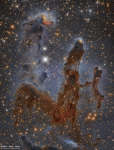 Pillars of the Eagle Nebula in Infrared
20.06.2018
Newborn stars are forming in the Eagle Nebula. Gravitationally contracting in pillars of dense gas and dust, the intense radiation of these newly-formed bright stars is causing surrounding material to boil away. This image...
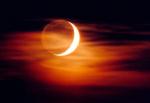 The Old Moon in the New Moon's Arms
19.04.2002
Also known as the Moon's "ashen glow" or "the old Moon in the new Moon's arms", Earthshine is Earthlight reflected from the Moon's night side. This dramatic image of Earthshine...
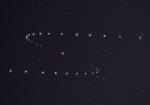 S is for Venus
7.01.2005
Planet Venus traced out this S shape in Earth's sky during 2004. Following the second planet from the Sun in a series of 29 images recorded from April 3rd through August...
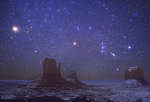 Mars and Orion Over Monument Valley
25.12.2007
Welcome to The World At Night. Sharing the night sky seen around the world, this view from Monument Valley, USA includes a picturesque foreground of famous buttes. Buttes are composed of hard volcanic rock left behind after water eroded away the surrounding soft rock.
 Americans Defeat Russians in First Space Quidditch Match
1.04.2001
A historic first Space Quidditch match came to a spectacular conclusion last night as astronaut Michael Lopez-Alegria caught the Golden Snitch to give the Americans a hard fought victory over the Russians. "The Russians...
|
January February March April May June July August September |
|||||||||||||||||||||||||||||||||||||||||||||||||