
|
You entered: galaxy center
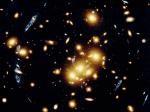 Giant Cluster Bends, Breaks Images
7.08.2004
What are those strange blue objects? Many are images of a single, unusual, beaded, blue, ring-like galaxy which just happens to line-up behind a giant cluster of galaxies. Cluster galaxies here appear yellow and -- together with the cluster's dark matter -- act as a gravitational lens.
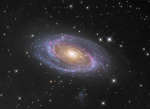 Messier 81
12.03.2021
One of the brightest galaxies in planet Earth's sky is similar in size to our Milky Way Galaxy: big, beautiful Messier 81. Also known as NGC 3031 or Bode's galaxy for its 18th century discoverer, this grand spiral can be found toward the northern constellation of Ursa Major, the Great Bear.
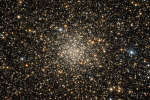 The Reddening of M71
9.12.2014
Now known to be a globular star cluster at the tender age of 10 billion years, M71 is a mere 13,000 light-years away within the narrow boundaries of the faint constellation Sagitta. Close...
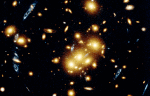 Giant Cluster Bends, Breaks Images
14.06.1998
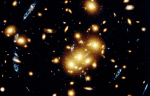
What are those strange blue objects? Many are images of a single, unusual, beaded, blue, ring-like galaxy which just happens to line-up behind a giant cluster of galaxies. Cluster galaxies here appear yellow and -- together with the cluster's dark matter -- act as a gravitational lens.
 Giant Cluster Bends, Breaks Galaxy Images
3.05.1997
What are those strange blue objects? Many are images of a single, unusual, beaded, blue, ring-like galaxy which just happens to line-up behind a giant cluster of galaxies. Cluster galaxies here appear yellow and -- together with the cluster's dark matter -- act as a gravitational lens.
 Massive Stars in NGC 6357
5.02.2016
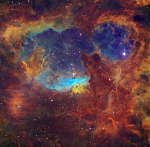
Massive stars lie within NGC 6357, an expansive emission nebula complex some 6,500 light-years away toward the tail of the constellation Scorpius. In fact, positioned near center in this ground-based close-up...
 Giant Cluster Bends, Breaks Galaxy Images
24.04.1996
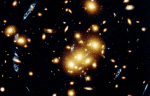
What are those strange blue objects? Many are images of a single, unusual, beaded, blue, ring-like galaxy which just happens to line-up behind a giant cluster of galaxies. Cluster galaxies here appear yellow and -- together with the cluster's dark matter -- act as a gravitational lens.
 Exploring The Universe With IUE (1978-1996)
30.09.1996
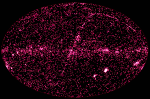
How do planets, stars, and galaxies form? How do they evolve? The International Ultraviolet Explorer (IUE) satellite was launched in 1978 and operated by NASA/ ESA/ PPARC to help provide answers to some of the most fundamental questions about the contents of our universe.
 Gamma Ray Sky Map
23.06.1995
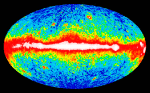
What if you could "see" gamma rays? This computer processed image represents a map of the entire sky at photon energies above 100 million electron Volts. These gamma-ray photons are more than 40 million times more energetic than visible light photons and are blocked from the Earth's surface by the atmosphere.
 Moving Echoes Around SN 1987A
24.10.1997
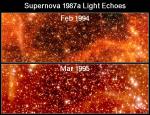
Yesterday's image highlighted reflective rings of light emitted by a supernova explosion. Today's pictures, taken over a year apart, highlight how these echoes are seen to move over time. Visible...
|
January February March April May June July August |
||||||||||||||||||||||||||||||||||||||||||||||||||||||||