
|
You entered: dark
 Martian Chiaroscuro
14.04.2018
Deep shadows create dramatic contrasts between light and dark in this high-resolution close-up of the martian surface. Recorded on January 24, 2014 by the HiRISE camera onboard the Mars Reconnaissance Orbiter, the scene spans about 1.5 kilometers.
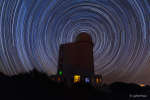 Circumpolar Star Trails
18.01.2019
As Earth spins on its axis, the stars appear to rotate around an observatory in this well-composed image from the Canary Island of Tenerife. Of course, the colorful concentric arcs traced out by the stars are really centered on the planet's North Celestial Pole.
 Little Planet South Pole
26.08.2022
Lights play around the horizon of this snowy little planet as it drifts through a starry night sky. Of course the little planet is actually planet Earth. Recorded on August 21, the digitally warped, nadir centered panorama covers nearly 360x180 degrees outside the Amundsen-Scott South Pole Station, Antarctica.
 The Orion Nebula in Hydrogen
22.11.2000
The Great Nebula in Orion can be found just below and to the left of the easily identifiable belt of three stars in the popular constellation Orion. This fuzzy patch, visible to the unaided eye, contains one of the closest stellar nurseries, lying at a distance of about 1500 light years.
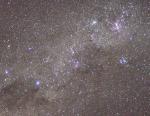 The Southern Sky from the International Space Station
7.05.2003
Look up from Earth's South Pole, and this stellar starscape is what you might see. Alternatively, this patch of sky is also visible from many southern locations as well as the orbiting International Space Station, where the above image was recently recorded.
 David N. Schramm, 1945 - 1997
22.12.1997
David N. Schramm effectively combined the very big with the very small. Among his many scientific achievements, Schramm and collaborators successfully used Big Bang cosmology to predict that only three families of elementary particles exist in the universe, which was subsequently confirmed by high energy particle accelerators.
 The Unusual Blueberries at Bylot Rock
17.08.2004
Why aren't these Martian rocks round? Small rocks dubbed blueberries have been found by the Opportunity rover all over Meridiani Planum on Mars, but the ones perched on Bylot rock have unusually non-spherical shapes. The strangely shaped blueberry rocks are shown above in an image taken by Opportunity's microscopic imager on August 9.
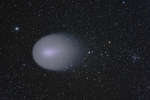 Comet Holmes Over Hungary
5.12.2007
Comet Holmes refuses to fade. The unusual comet that surprisingly brightened nearly a million-fold in late October continues to remain visible to the unaided eye from dark locations. Night to night, Comet 17P/Holmes is slowly gliding through the constellation Perseus, remaining visible to northern observers during much of the night right from sunset.
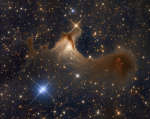 Ghost of the Cepheus Flare
30.10.2010
Spooky shapes seem to haunt this starry expanse, drifting through the night in the royal constellation Cepheus. Of course, the shapes are cosmic dust clouds faintly visible in dimly reflected starlight. Far from your...
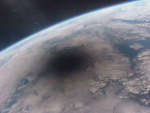 Looking Back at an Eclipsed Earth
2.01.2011
Here is what the Earth looks like during a solar eclipse. The shadow of the Moon can be seen darkening part of Earth. This shadow moved across the Earth at nearly 2000 kilometers per hour.
|
January February March April May June July August September |
|||||||||||||||||||||||||||||||||||||||||||||||||