
|
You entered: composite image
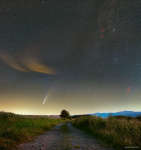 Comet NEOWISE and Nebulae
20.07.2020
Would you brave wild animals to photograph this sky? One astrophotographer did -- and we all get to reap the rewards. First, thousands of stars were visible with many of the brightest impressively blue. Next, several red-glowing nebulae were discernible, including the California Nebula on the far right, and, above it, the Heart and Soul nebulae.
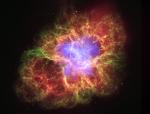 Composite Crab
26.10.2006
The Crab Nebula is cataloged as M1, the first object on Charles Messier's famous list of things which are not comets. In fact, the Crab is now known to be a supernova remnant, expanding debris from the death explosion of a massive star.
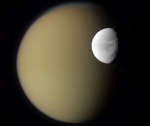 Saturns Moons Dione and Titan from Cassini
20.04.2010
What would it be like to see a sky with many moons? Such is the sky above Saturn. When appearing close to each other, moons will show a similar phase. A view with...
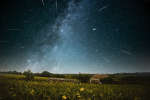 Three Perseid Nights
20.08.2021
Frames from a camera that spent three moonless nights under the stars create this composite night skyscape. They were recorded during August 11-13 while planet Earth was sweeping through the dusty trail of comet Swift-Tuttle.
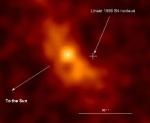 X-Rays from Comet LINEAR
1.08.2000
Why do comets emit X-rays? First discovered during the passing of Comet Hyakutake in 1996, the reason a cold comet would produce hot X-rays has since remained a mystery. On July 14, however...
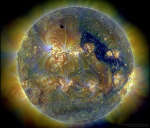 Venus and the Triply Ultraviolet Sun
6.03.2022
This was a very unusual type of solar eclipse. Typically, it is the Earth's Moon that eclipses the Sun. In 2012, though, the planet Venus took a turn. Like a solar eclipse by the Moon, the phase of Venus became a continually thinner crescent as Venus became increasingly better aligned with the Sun.
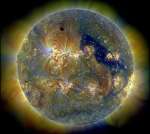 Venus and the Triply Ultraviolet Sun
20.08.2013
An unusual type of solar eclipse occurred last year. Usually it is the Earth's Moon that eclipses the Sun. Last June, most unusually, the planet Venus took a turn. Like a solar eclipse by the Moon, the phase of Venus became a continually thinner crescent as Venus became increasingly better aligned with the Sun.
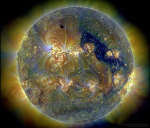 Venus and the Triply Ultraviolet Sun
4.02.2018
An unusual type of solar eclipse occurred in 2012. Usually it is the Earth's Moon that eclipses the Sun. That year, most unusually, the planet Venus took a turn. Like a solar eclipse by the Moon, the phase of Venus became a continually thinner crescent as Venus became increasingly better aligned with the Sun.
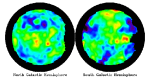 COBE Hotspots: The Oldest Structures Known
6.02.1996
Above are two microwave images of the sky, looking north and south of our galaxy's equator, based on data from NASA's COBE satellite. After computer processing to remove contributions from nearby objects and the effects of the earth's motion, they show "spots".
 APOD: 2025 March 16 Б Venus and the Triply Ultraviolet Sun
16.03.2025
This was a very unusual type of solar eclipse. Typically, it is the Earth's Moon that eclipses the Sun. In 2012, though, the planet Venus took a turn. Like a solar eclipse by the Moon, the phase of Venus became a continually thinner crescent as Venus became increasingly better aligned with the Sun.
|
January February March April May June July August September |
|||||||||||||||||||||||||||||||||||||||||||||||||