
|
You entered: image
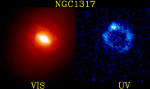 Starburst Ring in Galaxy NGC 1317
11.12.1996
Where do stars form? A typical place is an area of dense nebular gas common to arms in spiral galaxies. Sometimes, however, a burst of star formation can occur with unusual geometry. Nearby galaxy NGC 1317 shows such an unusual ring of star formation surrounding its barred nucleus.
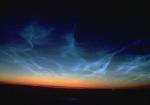 Noctilucent Clouds
15.06.2003
Sometimes it's night on the ground but day in the air. As the Earth rotates to eclipse the Sun, sunset rises up from the ground. Therefore, at sunset on the ground, sunlight still shines on clouds above.
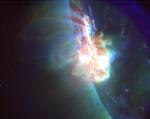 An Active Region of the Sun
16.06.1998
The Sun is a busy place. This false-color image depicts an active region near an edge of the Sun. Hot plasma is seen exploding off the Sun's photosphere and traveling along loops defined by the Sun's magnetic field.
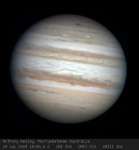 Jupiter s Impact Scar
23.07.2009
In July of 1994 pieces of Comet Shoemaker-Levy 9 collided with planet Jupiter. The explosive impacts sent plumes of debris high into the Jovian atmosphere creating dark markings or scars, visible for a time against the cloud bands.
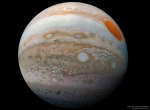 Jupiter Marble from Juno
8.05.2019
What does Jupiter look like up close? Most images of Jupiter are taken from far away, either from Earth or from a great enough distance that nearly half the planet is visible. This shot, though, was composed from images taken relatively close in, where less than half of the planet was visible.
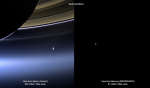 Interplanetary Earth
12.10.2019
In an interplanetary first, on July 19, 2013 Earth was photographed on the same day from two other worlds of the Solar System, innermost planet Mercury and ringed gas giant Saturn. Pictured...
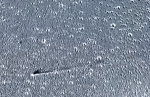 Comet Leonards Tail Wag
10.01.2022
Why does Comet Leonard's tail wag? The featured time-lapse video shows the ion tail of Comet C/2021 A1 (Leonard) as it changed over ten days early last month. The video was taken by NASA's Solar Terrestrial Relations Observatory-Ahead (STEREO-A) spacecraft that co-orbits the Sun at roughly the same distance as the Earth.
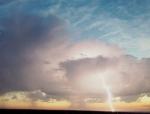 Venus Beyond the Storm
10.09.2002
A thunderstorm, lightning, a bright star and a bright planet all graced an evening sky for a short while near Bismarck, North Dakota, USA two weeks ago. Thick thunderclouds from a passing storm are the origin of a strong cloud to ground lightning strike.
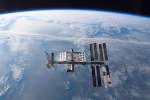 The International Space Station Expands Again
5.03.2008
The developing International Space Station (ISS) has changed its appearance again. Last month, the Space Shuttle orbiter Atlantis visited the ISS and added components that included the Columbus Science Laboratory. The entire array of expansive solar panels is visible in this picture taken by the Atlantis Crew after leaving the ISS to return to Earth.
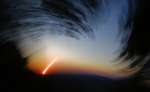 A View to the Sunset
31.05.2008
Each day on planet Earth can have a dramatic ending as the Sun sets below the colorful western horizon. Often inspiring, or offering a moment for contemplation, a sunset is perhaps the single most photographed celestial event. Did you recognize this as a picture of one?
|
January February March April May June July August September |
|||||||||||||||||||||||||||||||||||||||||||||||||