
|
You entered: dark cloud
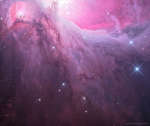 M43: Orion Falls
12.12.2018
Is there a waterfall in Orion? No, but some of the dust in M43 appears similar to a waterfall on Earth. M43, part of the Orion Molecular Cloud Complex, is the often imaged but rarely mentioned neighbor of the more famous M42.
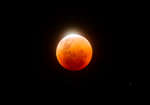 A Jewel on the Flower Moon
18.05.2022
Cloudy skies plagued some sky watchers on Sunday as May's Full Flower Moon slipped through Earth's shadow in a total lunar eclipse. In skies above Chile's Atacama desert this telephoto snapshot still captured an awesome spectacle though.
 Look West for a NEAT Comet
7.05.2004
On May 5th, while scanning western skies after sunset, astronomer Jimmy Westlake was glad to spot a visitor from the outer solar system, Comet NEAT, with his own eyes. Taken with a normal lens...
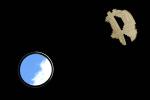 Pantheon Earth and Moon
20.04.2007
Could this be a picture of the Earth and Moon from space? It certainly looks like it at first glance, with a dark, cratered Moon standing off from planet Earth's lovely blue disk surrounded by a nurturing atmosphere. In fact, this view looks up into the dome of the ancient Pantheon in Rome.
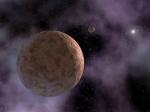 Sedna of the Outer Solar System
16.03.2004
What is the most distant known object in our Solar System? A new answer to this centuries-old question was announced yesterday by NASA with the discovery of a dark red object dubbed Sedna. Although over twice the distance to Pluto, Sedna is near its closest approach to the Sun.
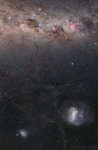 Galaxies and the South Celestial Pole
1.01.2021
The South Celestial Pole is easy to spot in star trail images of the southern sky. The extension of Earth's axis of rotation to the south, it's at the center of all the southern star trail arcs.
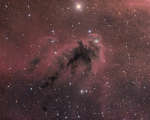 LDN 1622: Dark Nebula in Orion
2.02.2019
The silhouette of an intriguing dark nebula inhabits this cosmic scene. Lynds' Dark Nebula (LDN) 1622 appears against a faint background of glowing hydrogen gas only easily seen in long telescopic exposures of the region.
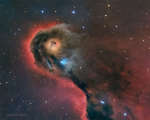 APOD: 2025 October 14 Б An Unusual Globule in IC 1396
14.10.2025
Is there a monster in IC 1396? Known to some as the Elephant's Trunk Nebula, parts of gas and dust clouds of this star formation region may appear to take on foreboding forms, some nearly human. The only real monster here, however, is a bright young star too far from Earth to hurt us.
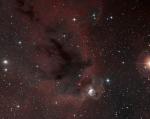 LDN 1622: Dark Nebula in Orion
11.05.2007
The silhouette of an intriguing dark nebula inhabits this cosmic scene, based on images from the Palomar Observatory Sky Survey. Lynds' Dark Nebula (LDN) 1622 appears against a faint background of glowing hydrogen gas only easily seen in long telescopic exposures of the region.
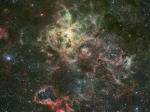 Tentacles of the Tarantula Nebula
22.08.2007
The largest, most violent star forming region known in the whole Local Group of galaxies lays in our neighboring galaxy the Large Magellanic Cloud (LMC). Were the Tarantula Nebula at the distance of the Orion Nebula -- a local star forming region -- it would take up fully half the sky.
|
January February March April May June July August September |
|||||||||||||||||||||||||||||||||||||||||||||||||