
|
You entered: dust cloud
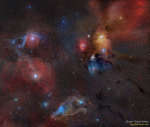 Rho Ophiuchi Wide Field
27.07.2014
The clouds surrounding the star system Rho Ophiuchi compose one of the closest star forming regions. Rho Ophiuchi itself is a binary star system visible in the light-colored region on the image right.
 Rho Ophiuchus Wide Field
24.05.2010
The clouds surrounding the star system Rho Ophiucus compose one of the closest star forming regions. Rho Ophiucus itself is a binary star system visible in the light-colored region on the image right.
 Hydrogen and Dust in the Rosette Nebula
23.12.2005
At the edge of a large molecular cloud in Monoceros, some 3,000 light years away, dark filaments of dust are silhouetted by luminous hydrogen gas. The close up view of the Rosette Nebula...
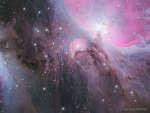 M43: Streams of Orion
6.10.2021
Where do the dark streams of dust in the Orion Nebula originate? This part of the Orion Molecular Cloud Complex, M43, is the often imaged but rarely mentioned neighbor of the more famous M42. M42, seen in part to the upper right, includes many bright stars from the Trapezium star cluster.
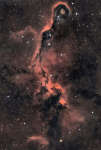 APOD: 2026 August 20 Б The Elephant s Trunk in Cepheus
20.08.2026
Like an illustration in a galactic Just So Story, the Elephant's Trunk Nebula winds through the emission region and young star cluster complex IC 1396, in the high and far off constellation of Cepheus. Also known as vdB 142, this cosmic elephant's trunk is over 20 light-years long.
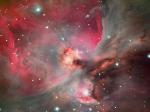 The Great Nebula in Orion
13.02.2002
Few astronomical sights excite the imagination like the nearby stellar nursery known as the Orion Nebula. The Nebula's glowing gas surrounds hot young stars at the edge of an immense interstellar molecular cloud only 1500 light-years away.
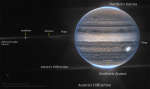 Jupiter from the Webb Space Telescope
30.08.2022
This new view of Jupiter is illuminating. High-resolution infrared images of Jupiter from the new James Webb Space Telescope (Webb) reveal, for example, previously unknown differences between high-floating bright clouds -- including the Great Red Spot -- and low-lying dark clouds.
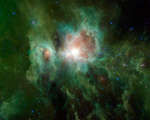 Infrared Orion from WISE
13.02.2013
The Great Nebula in Orion is a intriguing place. Visible to the unaided eye, it appears as a small fuzzy patch in the constellation of Orion. But this image, an illusory-color composite of four...
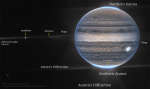 APOD: 2026 January 18 Б Jupiter from the Webb Space Telescope
18.01.2026
This infrared view of Jupiter by Webb is illuminating. High-resolution infrared images of Jupiter from the James Webb Space Telescope (Webb) reveal, for example, differences between high-floating bright clouds -- including the Great Red Spot -- and low-lying dark clouds.
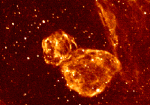 Colliding Supernova Remnants
2.10.1997
When a massive star exhausts its nuclear fuel it explodes. This stellar detonation, a supernova, propels vast amounts of starstuff outwards, initially at millions of miles per hour. For another 100,000 years...
|
January February March April May June July August September |
|||||||||||||||||||||||||||||||||||||||||||||||||