
|
You entered: Observatory
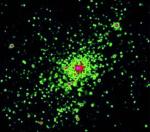 NGC 3603: X-Rays From A Starburst Cluster
24.01.2001
A mere 20,000 light-years from the Sun lies the NGC 3603 star cluster, a resident of the nearby Carina spiral arm of our Milky Way galaxy. Seen here in this recent false-color x-ray...
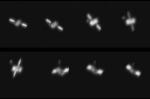 Compton Returns
7.03.2001
On 2000 June 4, the 17-ton Compton Gamma-Ray Observatory returned to Earth after 9 years in orbit -- ending its remarkable voyage of discovery. The massive, bus-sized spacecraft carried an unprecedented array of gamma-ray detectors which explored the bizarre, high-energy universe of solar flares, black holes, pulsars, supernovae, active galaxies, and gamma-ray bursts.
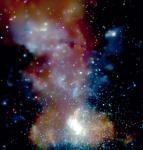 Galactic Center Star Clusters
10.08.2006
If you had x-ray vision, the central regions of our Galaxy would not be hidden from view by cosmic dust clouds. Instead, the Milky Way toward Sagittarius might look something like this. Pleasing...
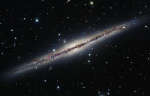 At the Edge of NGC 891
26.05.2012
This sharp cosmic portrait features NGC 891. The spiral galaxy spans about 100 thousand light-years and is seen almost exactly edge-on from our perspective. In fact, about 30 million light-years distant in the constellation Andromeda, NGC 891 looks a lot like our Milky Way.
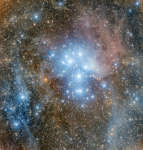 Messier 45: The Daughters of Atlas and Pleione
7.11.2019
Hurtling through a cosmic dust cloud a mere 400 light-years away, the lovely Pleiades or Seven Sisters open star cluster is well-known for its striking blue reflection nebulae. It lies in the night sky toward the constellation Taurus and the Orion Arm of our Milky Way Galaxy.
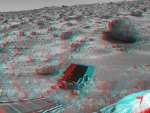 Yogi And Friends in 3D
22.08.2020
From July of 1997, a ramp from the Pathfinder lander, the Sojourner robot rover, airbags, a couch, Barnacle Bill and Yogi Rock appear together in this 3D stereo view of the surface of Mars. Barnacle Bill is the rock just left of the solar-paneled Sojourner. Yogi is the big friendly-looking boulder at top right.
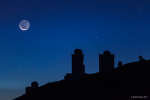 Mercury and the Da Vinci Glow
10.07.2021
On July 8th early morning risers saw Mercury near an old Moon low on the eastern horizon. On that date bright planet, faint glow of lunar night side, and sunlit crescent were captured in this predawn skyscape from Tenerife's Teide National Park in the Canary Islands.
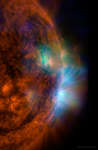 The Sun in X rays from NuSTAR
23.11.2021
Why are the regions above sunspots so hot? Sunspots themselves are a bit cooler than the surrounding solar surface because the magnetic fields that create them reduce convective heating. It is therefore unusual that regions overhead -- even much higher up in the Sun's corona -- can be hundreds of times hotter.
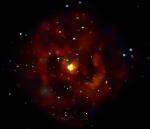 X Rays from M83
6.02.2003
Bright and beautiful spiral galaxy M83 lies a mere twelve million light-years from Earth, toward the headstrong constellation Hydra. Sweeping spiral arms, prominent in visible light images, lend this galaxy its popular moniker -- the Southern Pinwheel.
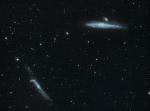 The Whale and the Hockey Stick
12.10.2007
NGC 4631 is a big beautiful spiral galaxy seen edge-on (top right) only 25 million light-years away towards the small northern constellation Canes Venatici. This galaxy's slightly distorted wedge shape suggests to some a cosmic herring and to others the popular moniker of The Whale Galaxy.
|
January February March April May June July August September October |
|||||||||||||||||||||||||||||||||||||||||||||||||