
|
You entered: apod
 APOD: 2020 August 19 Б The Sun Rotating
19.08.2020
Does the Sun change as it rotates? Yes, and the changes can vary from subtle to dramatic. In the featured time-lapse sequences, our Sun -- as imaged by NASA's Solar Dynamics Observatory -- is shown rotating though an entire month in 2014.
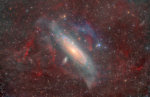 APOD: 2026 June 3 Б Andromeda Through Gas and Dust
3.06.2026
Over 1000 years ago, Persian astronomer Abd al-Rahman al-Sufi published humanityБs oldest known record of the Andromeda Galaxy in "The Book of Fixed Stars" (Bodleian Library MS. Marsh 144 p. 167). 800 years later, Andromeda became the 31st entry in Charles MessierБs "Catalogue of Nebulae and Star Clusters".
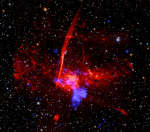 APOD: 2026 June 18 Б Possible Supernova Remnant in Galactic Center
18.06.2026
Do you see that blue blob to the lower right of the image center? Astronomers think that it shows where a massive star exploded as a supernova whose light reached Earth 1,700 years ago.
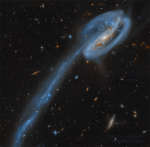 APOD: 2024 July 15 Б The Tadpole Galaxy from Hubble
15.07.2024
Why does this galaxy have such a long tail? In this stunning vista, based on image data from the Hubble Legacy Archive, distant galaxies form a dramatic backdrop for disrupted spiral galaxy Arp 188, the Tadpole Galaxy. The cosmic tadpole is a mere 420 million light-years distant toward the northern constellation of the Dragon (Draco).
 APOD: 2024 April 21 Б Perijove 16: Passing Jupiter
21.04.2024
Watch Juno zoom past Jupiter. NASA's robotic spacecraft Juno is continuing on its now month-long, highly-elongated orbits around our Solar System's largest planet. The featured video is from perijove 16, the sixteenth time that Juno passed near Jupiter since it arrived in mid-2016.
 APOD: 2025 May 6 Б The Doubly Warped World of Binary Black Holes
6.05.2025
If one black hole looks strange, what about two? Light rays from accretion disks around a pair of orbiting supermassive black holes make their way through the warped space-time produced by extreme gravity in this detailed computer visualization.
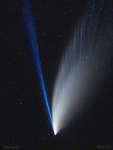 APOD: 2020 July 22 Б The Structured Tails of Comet NEOWISE
22.07.2020
What is creating the structure in Comet NEOWISE's tails? Of the two tails evident, the blue ion tail on the left points directly away from the Sun and is pushed out by the flowing and charged solar wind.
 APOD: 2023 December 31 Б Illustris: A Simulation of the Universe
31.12.2023
How did we get here? Click play, sit back, and watch. A computer simulation of the evolution of the universe provides insight into how galaxies formed and perspectives into humanity's place in the universe.
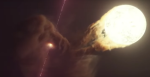 APOD: 2020 August 31 Б SS 433: Binary Star Micro Quasar
31.08.2020
SS 433 is one of the most exotic star systems known. Its unremarkable name stems from its inclusion in a catalog of Milky Way stars which emit radiation characteristic of atomic hydrogen. Its remarkable behavior stems from a compact object, a black hole or neutron star, which has produced an accretion disk with jets.
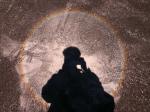 Identify this Phenomenon
13.09.2004
What caused this ring of colors? At the time of this writing, MIT Physics Professor Walter Lewin had yet to find someone who can give the correct explanation. Not students. Not colleagues. Not APOD editors. He wonders how the astute readers of APOD will do. Can you match wits with Professor Lewin?
|
January February March April May June July August September |
|||||||||||||||||||||||||||||||||||||||||||||||||