
|
You entered: unusual
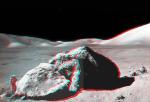 Apollo 17: Boulder in Stereo
11.01.2003
Humans left the Moon over thirty years ago, but donning red-blue glasses (red for the left eye) you can share this excellent stereo perspective view of their last stomping ground. Recorded by Eugene Cernan...
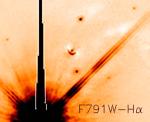 Diffraction Spikes: When Stars Look Like Crosses
19.11.1997
Unusual appendages around bright stars are commonplace, but never seem to be mentioned. What are they? First, a telescope brings starlight falling over a large area to a small area. To get at this...
 A Total Eclipse at the End of the World
15.01.2011
Would you go to the end of the world to see a total eclipse of the Sun? If you did, would you be surprised to find someone else there already? In 2003, the Sun, the Moon, Antarctica, and two photographers all lined up in Antarctica during an unusual total solar eclipse.
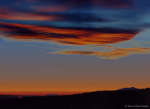 Mercury on the Horizon
17.07.2016
Have you ever seen the planet Mercury? Because Mercury orbits so close to the Sun, it never wanders far from the Sun in Earth's sky. If trailing the Sun, Mercury will be visible low on the horizon for only a short while after sunset.
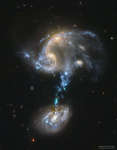 Arp 194: Merging Galaxy Group
25.03.2019
Why are stars forming in the bridge between these colliding galaxies? Usually when galaxies crash, star formation is confined to galaxy disks or tidal tails. In Arp 194, though, there are bright knots of young stars right in a connecting bridge.
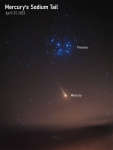 Mercurys Sodium Tail
3.05.2022
That's no comet. Below the Pleiades star cluster is actually a planet: Mercury. Long exposures of our Solar System's innermost planet may reveal something unexpected: a tail. Mercury's thin atmosphere contains small amounts of sodium that glow when excited by light from the Sun.
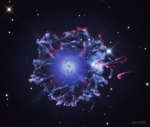 Halo of the Cats Eye
3.08.2022
What created the unusual halo around the Cat's Eye nebula? No one is sure. What is sure is that the Cat's Eye Nebula (NGC 6543) is one of the best known planetary nebulae on the sky.
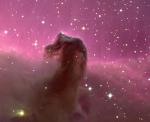 The Horsehead Nebula
19.05.1999
One of the most identifiable nebulae in the sky, the Horsehead Nebula in Orion, is part of a large, dark, molecular cloud. Also known as Barnard 33, the unusual shape was first discovered on a photographic plate in the late 1800s.
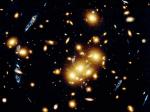 Giant Cluster Bends, Breaks Images
10.06.2001
What are those strange blue objects? Many are images of a single, unusual, beaded, blue, ring-like galaxy which just happens to line-up behind a giant cluster of galaxies. Cluster galaxies here appear yellow and -- together with the cluster's dark matter -- act as a gravitational lens.
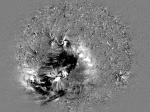 The Sun Puffs
29.10.2006
Our Earth endures bursts of particles from the Sun. On 1997 April 7, at 10 am (EDT), ground monitors of the SOHO spacecraft, which continually monitors the Sun, noticed a weak spot in the solar corona was buckling again, this time letting loose a large, explosive Coronal Mass Ejection (CME).
|
January February March April May June July August September |
|||||||||||||||||||||||||||||||||||||||||||||||||