
|
You entered: night sky
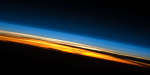 Sunset from the International Space Station
23.06.2010
What are these strange color bands being seen from the International Space Station? The Sun setting through Earth's atmosphere. Pictured above, a sunset captured last month by the ISS's Expedition 23 crew shows in vivid detail many layers of the Earth's thin atmosphere.
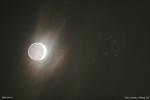 Young Moon and Sister Stars
28.04.2007
A young crescent Moon shared the western sky with thin clouds and the sister stars of the Pleiades cluster in this early evening skyscape recorded on April 19th. Astronomical images of the well-known Pleiades often show the star cluster's alluring blue reflection nebulae, but they are washed-out here in the clouds and bright moonlight.
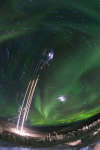 A Night at Poker Flat
29.01.2015
Four NASA suborbital sounding rockets leapt into the night on January 26, from the University of Alaska's Poker Flat Research Range. This time lapse composite image follows all four launches of the small, multi-stage rockets to explore winter's mesmerizing, aurora-filled skies.
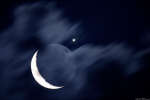 Moon Meets Jupiter
20.07.2012
Skygazers around planet Earth enjoyed the close encounter of planets and Moon in July 15's predawn skies. And while many saw bright Jupiter next to the slender, waning crescent, Europeans also...
 Comet Meets Moon and Morning Star
12.12.2015
A crescent Moon and brilliant Venus met in predawn skies on December 7, a beautiful conjunction of planet Earth's two brightest celestial beacons after the Sun. Harder to see but also on the scene was Comet Catalina (C/2013 US10).
 Sunset at the Portara
20.03.2009
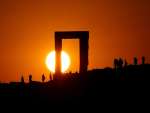
Today, the Sun crosses the celestial equator heading north at 11:44 UT. Known as an equinox, this astronomical event marks the first day of spring in the northern hemisphere and autumn in the south. It also marks the beginning of Norouz, the Persian (Iranian) new year. Equinox means equal night.
 Corona from Svalbard
31.03.2015
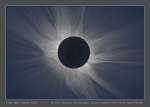
During a total solar eclipse, the Sun's extensive outer atmosphere, or corona, is an inspirational sight. Streamers and shimmering features that engage the eye span a brightness range of over 10,000 to 1, making them notoriously difficult to capture in a single photograph.
 Aurora Australis and the International Space Station
13.09.2024
This snapshot from the International Space Station was taken on August 11 while orbiting about 430 kilometers above the Indian Ocean, Southern Hemisphere, planet Earth. The spectacular view looks south and east, down toward the planet's horizon and through red and green curtains of aurora australis.
 Moon Meets Jupiter
10.07.2016
What's that next to the Moon? Jupiter -- and its four largest moons. Skygazers around planet Earth enjoyed the close encounter of planets and Moon in 2012 July 15's predawn skies. And while...
 Cave with Aurora Skylight
22.07.2014
Yes, but have you ever seen aurora from a cave? To capture this fascinating juxtaposition between below and above, astrophotographer Bjargmundsson spent much of a night alone in the kilometer-long RaufarhСlshellir lava cave in Iceland during late March. There, he took separate images of three parts of the cave using a strobe for illumination.
|
January February |
|||||||||||||||||||||||||||||||||||||||||||||||||