
|
You entered: Solar System
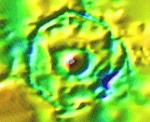 Mjølnir: Impact Crater
10.06.1999
The stark surface of Earth's moon is pocked with large craters, records of a history of fierce bombardment by the solar system's formative debris. It may be difficult to imagine, but nearby planet Earth itself has endured a similar cosmic pounding, though oceans, weathering, and geological
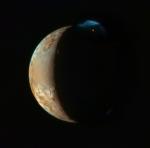 New Horizons at Io
4.04.2007
Spewed from a volcano, a complex plume rises over 300 kilometers above the horizon of Jupiter's moon Io in this image from cameras onboard the New Horizons spacecraft. The volcano, Tvashtar, is marked by the bright glow (about 1 o'clock) at the moon's edge, beyond the terminator or night/day shadow line.
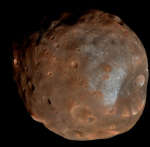 Phobos: Doomed Moon of Mars
14.04.2008
This moon is doomed. Mars, the red planet named for the Roman god of war, has two tiny moons, Phobos and Deimos, whose names are derived from the Greek for Fear and Panic. These...
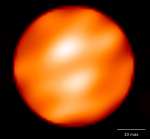 The Spotty Surface of Betelgeuse
6.01.2010
Betelgeuse really is a big star. If placed at the center of our Solar System it would extend to the orbit of Jupiter. But like all stars except the Sun, Betelgeuse is so distant it usually appears as a single point of light, even in large telescopes.
 The Orion Bullets
3.03.2019
Why are bullets of gas shooting out of the Orion Nebula? Nobody is yet sure. First discovered in 1983, each bullet is actually about the size of our Solar System, and moving at about 400 km/sec from a central source dubbed IRc2.
 APOD: 2023 April 25 Б Northern Lights over Southern Europe
25.04.2023
Did you see an aurora over the past two nights? Many people who don't live in Earth's far north did. Reports of aurora came in not only from northern locales in the USA as Alaska, but as far south as Texas and Arizona. A huge auroral oval extended over Europe and Asia, too.
 Mu Cephei
12.10.2023
Mu Cephei is a very large star. An M-class supergiant some 1500 times the size of the Sun, it is one of the largest stars visible to the unaided eye, and even one of the largest in the entire Galaxy.
 The Helix Nebula in Infrared
20.09.2016
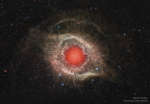
What makes this cosmic eye look so red? Dust. The featured image from the robotic Spitzer Space Telescope shows infrared light from the well-studied Helix Nebula (NGC 7293) a mere 700 light-years away in the constellation of the Water Carrier Aquarius.
 Saturn at Night
2.11.2024
Saturn is bright in Earth's night skies. Telescopic views of the outer gas giant planet and its beautiful rings often make it a star at star parties. But this stunning view of Saturn's rings and night side just isn't possible from telescopes in the vicinity of planet Earth.
 Cassini At Jupiter: Red Spot Movie
23.11.2000
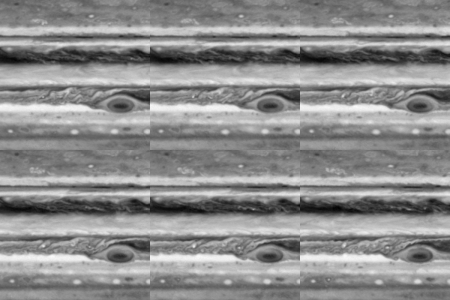
Everything is big on Jupiter, the solar system's reigning gas giant. For example, Jupiter's Great Red Spot is a hurricane-like storm system at least twice the diameter of planet Earth. Approaching Jupiter...
|
January February March April May June July August September October November |
||||||||||||||||||||||||||||||||||||||||||||||||||||||||