
|
You entered: spiral galaxy
 APOD: 2025 May 12 Б Gaia Reconstructs a Side View of our Galaxy
12.05.2025
What does our Milky Way Galaxy look like from the side? Because we are on the inside, humanity canБt get an actual picture. Recently, however, just such a map has been made using location data for over a billion stars from ESAБs Gaia mission.
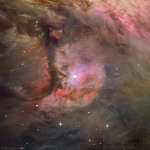 M43: Dust, Gas, and Stars in the Orion Nebula
6.07.2020
Unspeakable beauty and unimaginable bedlam can be found together in the Orion Nebula Arguably the most famous of all astronomy nebulas, the Great Nebula in Orion is an immense interstellar molecular cloud only 1500 light-years away.
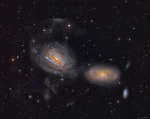 Unraveling NGC 3169
2.03.2023
Spiral galaxy NGC 3169 looks to be unraveling like a ball of cosmic yarn. It lies some 70 million light-years away, south of bright star Regulus toward the faint constellation Sextans. Wound up spiral arms are pulled out into sweeping tidal tails as NGC 3169 (left) and neighboring NGC 3166 interact gravitationally.
 Unraveling NGC 3169
23.05.2024
Spiral galaxy NGC 3169 looks to be unraveling like a ball of cosmic yarn. It lies some 70 million light-years away, south of bright star Regulus toward the faint constellation Sextans. Wound up spiral arms are pulled out into sweeping tidal tails as NGC 3169 (left) and neighboring NGC 3166 interact gravitationally.
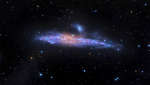 Star Streams and the Whale Galaxy
19.12.2015
NGC 4631 is a spiral galaxy found only 25 million light-years away, toward the well-trained northern constellation Canes Venatici. Seen ege-on, the galaxy is similar in size to the Milky Way. Its distorted wedge shape suggests to some a cosmic herring and to others its popular moniker, The Whale Galaxy.
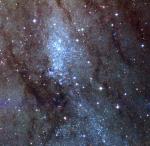 Stars of NGC 206
2.04.1999
Nestled within the dusty arms of the large spiral galaxy Andromeda (M31), the star cluster NGC 206 is one of the largest star forming regions known in our local group of galaxies. The beautiful...
 Galaxies in the River
27.07.2023
Large galaxies grow by eating small ones. Even our own galaxy engages in a sort of galactic cannibalism, absorbing small galaxies that are too close and are captured by the Milky Way's gravity.
 M83: Star Streams and a Thousand Rubies
3.07.2024
Big, bright, and beautiful, spiral galaxy M83 lies a mere twelve million light-years away, near the southeastern tip of the very long constellation Hydra. About 40,000 light-years across, M83 is known as the Southern Pinwheel for its pronounced spiral arms.
 APOD: 2025 April 9 Б HH 49: Interstellar Jet from Webb
9.04.2025
What's at the tip of this interstellar jet? First let's consider the jet: it is being expelled by a star system just forming and is cataloged as Herbig-Haro 49 (HH 49). The star system expelling this jet is not visible -- it is off to the lower right.
 The Big Dipper
24.06.2011
The best known asterism in northern skies, The Big Dipper is easy to recognize, though some might see The Plough. Either way, the star names and the familiar outlines will appear in this thoughtfully composed 24 frame mosaic when you slide your cursor over the image.
|
January February March April May June July August September October |
|||||||||||||||||||||||||||||||||||||||||||||||||