
|
You entered: emission
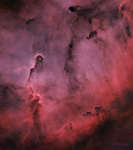 Elephant s Trunk and Caravan
27.08.2021
Like an illustration in a galactic Just So Story, the Elephant's Trunk Nebula winds through the emission nebula and young star cluster complex IC 1396, in the high and far off constellation of Cepheus. Also known as vdB 142, seen on the left the cosmic elephant's trunk is over 20 light-years long.
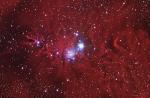 Fox Fur, the Unicorn, and a Christmas Tree
28.02.2003
Glowing hydrogen gas fills this gorgeously detailed sky view centered on the variable star S Mon in the faint but fanciful constellation Monoceros, the Unicorn. A star forming region (NGC 2264), the complex jumble...
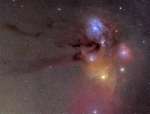 The Dark River to Antares
8.07.2009
Connecting the Pipe Nebula to the colorful regon near bright star Antares is a dark cloud dubbed the Dark River, flowing from the picture's left edge. Murky looking, the Dark River's appearance is caused by dust obscuring background starlight, although the dark nebula contains mostly hydrogen and molecular gas.
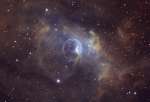 The Bubble Nebula
2.09.2010
Blown by the wind from a massive star, this interstellar apparition has a surprisingly familiar shape. Cataloged as NGC 7635, it is also known simply as The Bubble Nebula. Although it looks delicate, the 10 light-year diameter bubble offers evidence of violent processes at work.
 Three Galaxies in Draco
16.10.2013
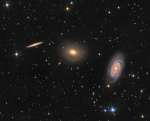
This intriguing trio of galaxies is sometimes called the Draco Group, located in the northern constellation of (you guessed it) Draco. From left to right are edge-on spiral NGC 5981, elliptical galaxy NGC 5982...
 Blue Comet in the Hyades
18.01.2018
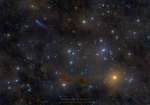
Stars of the Hyades cluster are scattered through this mosaic spanning over 5 degrees on the sky toward the constellation Taurus. Presently cruising through the Solar System, the remarkably blue comet C/2016 R2 PanSTARRS is placed in the wide field of view using image data from January 12.
 Wide Field: Fox Fur, Unicorn, and Christmas Tree
10.03.2020
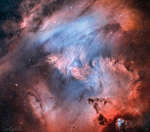
What do the following things have in common: a cone, the fur of a fox, and a Christmas tree? Answer: they all occur in the constellation of the unicorn (Monoceros). Pictured as a star...
 Galaxies in the Furnace
4.12.2025
An example of violence on a cosmic scale, enormous elliptical galaxy NGC 1316 lies about 75 million light-years away toward Fornax, the southern constellation of the Furnace. Investigating the startling sight, astronomers suspect...
 Composite Crab
26.03.2005
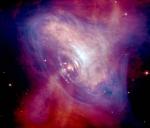
(xxxre linkxxx) The Crab Pulsar, a city-sized, magnetized neutron star spinning 30 times a second, lies at the center of this composite image of the inner region of the well-known Crab Nebula. The spectacular...
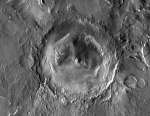 Gale Crater
29.07.2011
This sharp view from the Thermal Emission Imaging System camera on NASA's Mars Odyssey orbiter is centered on 154 kilometer (96 mile) wide Gale crater, near the martian equator. Within Gale, an impressive layered mountain rises about 5 kilometers (3 miles) above the crater floor.
|
January February March April May June July August |
||||||||||||||||||||||||||||||||||||||||||||||||||||||||