
|
You entered: radio galaxy
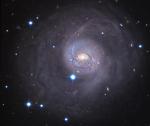 The Outskirts of M77
6.12.2006
Face-on spiral galaxy M77 lies a mere 60 million light-years away toward the constellation Cetus. Also known as NGC 1068, it's very bright core is well studied by astronomers exploring the mysteries of supermassive black holes in active galaxies.
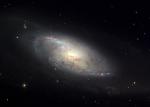 M106 in Canes Venatici
30.07.2005
Close to the Great Bear (Ursa Major) and surrounded by the stars of the Hunting Dogs (Canes Venatici), this celestial nebula was discovered in 1781 by the metric French astronomer Pierre Mechain. Later, it was added to the catalog of his friend and colleague Charles Messier as M106.
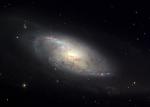 M106 in Canes Venatici
17.04.2003
Close to the Great Bear (Ursa Major) and surrounded by the stars of the Hunting Dogs (Canes Venatici), this celestial nebula was discovered in 1781 by the metric French astronomer Pierre Mechain and later added to the catalog of his friend and colleague Charles Messier as M106.
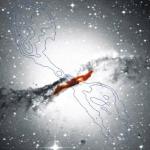 Centaurus A: The Galaxy Deep Inside
1.02.2002
Deep inside Centaurus A, the closest active galaxy to Earth, lies ... another galaxy! Cen A is a giant elliptical galaxy a mere 10 million light-years distant with a central jumble of stars, dust, and gas that probably hides a massive black hole.
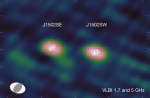 J1502 1115: A Triple Black Hole Galaxy
7.07.2014
Most galaxies contain one supermassive black hole -- why does this galaxy have three? The likely reason is that galaxy J1502+1115 is the product of the recent coalescence of three smaller galaxies.
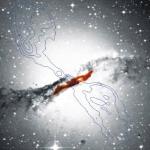 Centaurus A: The Galaxy Deep Inside
3.12.1998
Deep inside Centaurus A, the closest active galaxy to Earth, lies ... another galaxy! Cen A is a giant elliptical galaxy a mere 10 million light-years distant with a central jumble of stars, dust, and gas that probably hides a massive black hole.
 APOD: 2023 April 3 Б The Galactic Center Radio Arc
2.04.2023
What causes this unusual curving structure near the center of our Galaxy? The long parallel rays slanting across the top of the featured radio image are known collectively as the Galactic Center Radio Arc and point out from the Galactic plane.
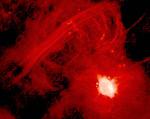 The Galactic Center Radio Arc
21.05.2002
What causes this unusual structure near the center of our Galaxy? The long parallel rays slanting across the top of the above radio image are known collectively as the Galactic Center Radio Arc and jut straight out from the Galactic plane.
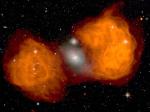 The Giant Radio Lobes of Fornax A
28.06.2005
Together, the radio lobes span over one million light years -- what caused them? In the center is a large but peculiar elliptical galaxy dubbed NGC 1316. Detailed inspection of the NGC 1316 system indicates that it began absorbing a small neighboring galaxy about 100 million years ago.
 The Galactic Center Radio Arc
3.04.2005
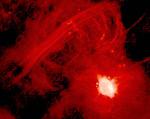
What causes this unusual structure near the center of our Galaxy? The long parallel rays slanting across the top of the above radio image are known collectively as the Galactic Center Radio Arc and jut straight out from the Galactic plane.
|
January February March April May June July August September October |
|||||||||||||||||||||||||||||||||||||||||||||||||