
|
You entered: merging galaxies
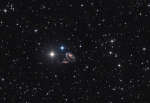 Peculiar Galaxies of Arp 273
5.01.2017
The spiky stars in the foreground of this sharp cosmic portrait are well within our own Milky Way Galaxy. The two eye-catching galaxies lie far beyond the Milky Way, at a distance of over 300 million light-years. Their distorted appearance is due to gravitational tides as the pair engage in close encounters.
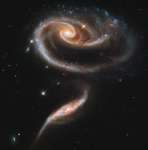 Peculiar Galaxies of Arp 273
21.04.2011
The spiky stars in the foreground of this sharp cosmic portrait are well within our own Milky Way Galaxy. The two eye-catching galaxies lie far beyond the Milky Way, at a distance of over 300 million light-years. Their distorted appearance is due to gravitational tides as the pair engage in close encounters.
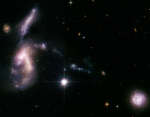 Galaxy Group Hickson 31
22.02.2010
Will the result of these galactic collisions be one big elliptical galaxy? Quite possibly, but not for another billion years. Pictured above, several of the dwarf galaxies of in the Hickson Compact Group 31 are seen slowly merging.
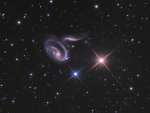 Arp 273
15.11.2008
The two prominent stars in the foreground of this colorful skyscape are well within our own Milky Way Galaxy. Their spiky appearance is due to diffraction in the astronomer's telescope. But the two eye-catching galaxies in view lie far beyond the Milky Way, at a distance of about 200 million light-years.
 The Outer Shells of Centaurus A
11.11.2002
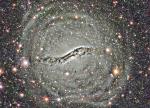
What causes the surrounding shells in peculiar galaxy Cen A? Last month a fascinating image of peculiar galaxy Centaurus A was released, processed to highlight a faint blue arc indicating an ongoing collision with a smaller galaxy.
 Galaxies in the GOODS
25.06.2003
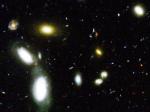
This tantalizing view of galaxies scattered near and far is part of the Hubble Space Telescope's contribution to the GOODS - the Great Observatories Origins Deep Survey project. The GOODS' goal is to study...
 The Outer Shells of Centaurus A
1.07.2012
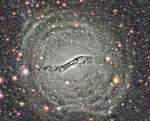
What causes the surrounding shells in peculiar galaxy Cen A? In 2002 a fascinating image of peculiar galaxy Centaurus A was released, processed to highlight a faint blue arc indicating an ongoing collision with a smaller galaxy.
 APOD: 2023 May 31 Б Simulation: A Disk Galaxy Forms
31.05.2023
How did we get here? We know that we live on a planet orbiting a star orbiting a galaxy, but how did all of this form? Since our universe moves too slowly to watch, faster-moving computer simulations are created to help find out.
 APOD: 2026 July 3 Б Three Galaxies in Pavo
3.07.2026
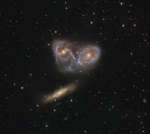
Some 190 million light-years away, far beyond the bright stars and nebulae of the Milky Way, these three galaxies are drawn together by gravity in a mesmerizing cosmic dance. Clearly distorted by galactic-scale gravitational interactions, large spiral galaxies NGC6769 and NGC6770 are seen face-on, with luminous galactic disks scarred by obscuring interstellar dust lanes.
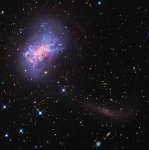 NGC 4449: Star Stream for a Dwarf Galaxy
26.01.2012
A mere 12.5 million light-years from Earth, irregular dwarf galaxy NGC 4449 lies within the confines of Canes Venatici, the constellation of the Hunting Dogs. About the size of our Milky Way's satellite...
|
January February March April May June July August September |
|||||||||||||||||||||||||||||||||||||||||||||||||