
|
You entered: iron
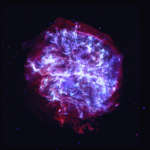 Elements in the Aftermath
1.08.2019
Massive stars spend their brief lives furiously burning nuclear fuel. Through fusion at extreme temperatures and densities surrounding the stellar core, nuclei of light elements ike Hydrogen and Helium are combined to heavier elements like Carbon, Oxygen, etc. in a progression which ends with Iron.
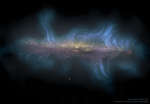 The Vertical Magnetic Field of NGC 5775
27.01.2021
How far do magnetic fields extend up and out of spiral galaxies? For decades astronomers knew only that some spiral galaxies had magnetic fields. However, after NRAO's Very Large Array (VLA) radio telescope...
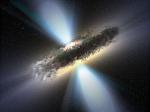 Molecular Torus Surrounds Black Hole
8.09.2004
Why do some black hole surroundings appear brighter than others? In the centers of active galaxies, supermassive black holes at least thousands of times the mass of our Sun dominate. Many, called Seyfert Type I, are very bright in visible light. Others, called Seyfert Type II, are rather dim.
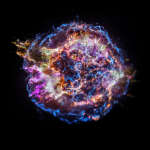 Recycling Cassiopeia A
28.12.2017
Massive stars in our Milky Way Galaxy live spectacular lives. Collapsing from vast cosmic clouds, their nuclear furnaces ignite and create heavy elements in their cores. After a few million years, the enriched material is blasted back into interstellar space where star formation can begin anew.
 APOD: 2024 January 3 Б A SAR Arc from New Zealand
3.01.2024
What is that unusual red halo surrounding this aurora? It is a Stable Auroral Red (SAR) arc. SAR arcs are rare and have only been acknowledged and studied since 1954. The featured wide-angle photograph...
 SNR 0104: An Unusual Suspect
12.06.2009
SNR 0104 is a supernova remnant with an unusual shape. Found 190,000 light-years away in our neighboring galaxy the Small Magellanic Cloud, SNR 0104 is suspected of being the expanding debris cloud from a Type 1a supernova - the catastrophic thermonuclear explosion of a white dwarf star.
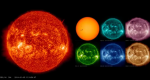 The Sun Rotating
12.03.2014
Does the Sun change as it rotates? Yes, and the changes can vary from subtle to dramatic. In the above time-lapse sequences, our Sun -- as imaged by NASA's Solar Dynamics Observatory -- is shown rotating though the entire month of January.
 APOD: 2020 August 19 Б The Sun Rotating
19.08.2020
Does the Sun change as it rotates? Yes, and the changes can vary from subtle to dramatic. In the featured time-lapse sequences, our Sun -- as imaged by NASA's Solar Dynamics Observatory -- is shown rotating though an entire month in 2014.
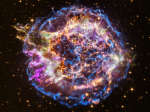 Recycling Cassiopeia A
6.09.2019
Massive stars in our Milky Way Galaxy live spectacular lives. Collapsing from vast cosmic clouds, their nuclear furnaces ignite and create heavy elements in their cores. After a few million years, the enriched material is blasted back into interstellar space where star formation can begin anew.
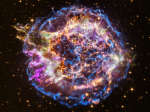 Recycling Cassiopeia A
23.01.2021
Massive stars in our Milky Way Galaxy live spectacular lives. Collapsing from vast cosmic clouds, their nuclear furnaces ignite and create heavy elements in their cores. After a few million years, the enriched material is blasted back into interstellar space where star formation can begin anew.
|
January February March April May |
|||||||||||||||||||||||||||||||||||||||||||||||||