
|
You entered: ionized hydrogen
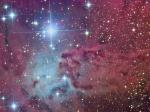 The Fox Fur Nebula
14.03.2005
The nebula surrounding bright star S Mon is filled with dark dust and glowing gas. The strange shapes originate from fine interstellar dust reacting in complex ways with the energetic light and hot gas being expelled by the young stars.
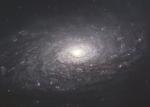 M63: The Sunflower Galaxy
27.06.2000
One of the bright spiral galaxies visible in the north sky is M63, the Sunflower Galaxy. M63, also catalogued as NGC 5055, can be found with a small telescope in the constellation of Canes Venaciti.
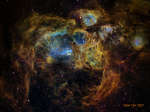 NGC 6357: The Lobster Nebula
26.12.2018
Why is the Lobster Nebula forming some of the most massive stars known? No one is yet sure. Cataloged as NGC 6357, the Lobster Nebula houses the open star cluster Pismis 24 near its center -- a home to unusually bright and massive stars.
 NGC 2244: A Star Cluster in the Rosette Nebula
17.03.2002
In the heart of the Rosette Nebula lies a bright open cluster of stars that lights up the nebula. The stars of NGC 2244 formed from the surrounding gas only four million years ago and emit light and wind that define the nebula's appearance today.
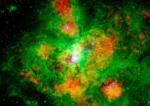 30 Doradus Across the Spectrum
24.12.1997
30 Doradus is lit up like a Christmas tree. Shining in light across the electromagnetic spectrum, 30 Doradus glows because of all the energetic processes that go on there. A distinctive region visible...
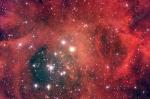 NGC 2244: A Star Cluster in the Rosette Nebula
22.08.2000
In the heart of the Rosette Nebula lies a bright open cluster of stars that lights up the nebula. The stars of NGC 2244 formed from the surrounding gas only four million years ago and emit light and wind that define the nebula's appearance today
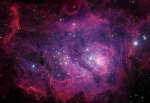 The Wide and Deep Lagoon
9.09.2016
Ridges of glowing interstellar gas and dark dust clouds inhabit the turbulent, cosmic depths of the Lagoon Nebula. Also known as M8, the bright star forming region is about 5,000 light-years distant.
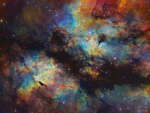 IC 1318: The Butterfly Nebula in Gas and Dust
16.03.2021
In the constellation of the swan near the nebula of the pelican lies the gas cloud of the butterfly next to a star known as the hen. That star, given the proper name Sadr...
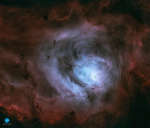 The Lagoon Nebula without Stars
8.08.2022
Ridges of glowing interstellar gas and dark dust clouds inhabit the turbulent, cosmic depths of the Lagoon Nebula. Also known as M8, the bright star forming region is about 5,000 light-years distant.
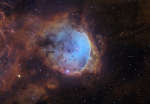 NGC 3324 in Carina
6.04.2018
This bright cosmic cloud was sculpted by stellar winds and radiation from the hot young stars of open cluster NGC 3324. With dust clouds in silhouette against its glowing atomic gas, the pocket-shaped star-forming region actually spans about 35 light-years. It lies some 7,500 light-years away toward the nebula rich southern constellation Carina.
|
January February March April May June July August September October |
|||||||||||||||||||||||||||||||||||||||||||||||||