
|
You entered: astronomy day
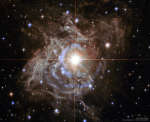 Nearby Cepheid Variable RS Pup
29.08.2018
In the center is one of the most important stars on the sky. This is partly because, by coincidence, it is surrounded by a dazzling reflection nebula. Pulsating RS Puppis, the brightest star in the image center, is some ten times more massive than our Sun and on average 15,000 times more luminous.
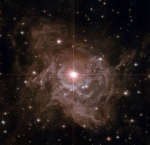 Nearby Cepheid Variable RS Pup
9.09.2013
It is one of the most important stars in the sky. This is partly because, by coincidence, it is surrounded by a dazzling reflection nebula. Pulsating RS Puppis, the brightest star in the image center, is some ten times more massive than our Sun and on average 15,000 times more luminous.
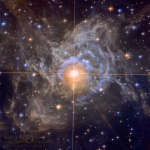 RS Puppis
17.05.2019
Pulsating RS Puppis, the brightest star in the image center, is some ten times more massive than our Sun and on average 15,000 times more luminous. In fact, RS Pup is a Cepheid...
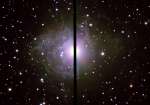 Echoes from RS Pup
12.02.2008
This dusty reflection nebula surrounds pulsating star RS Pup, some 10 times more massive than the Sun and on average 15,000 times more luminous. In fact, RS Pup is a Cepheid type variable...
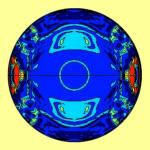 Solar Neutrino Astronomy
17.05.2001
Neutrinos are subatomic particles generated by the nuclear reactions which power stars like our Sun. Flying outward from the Sun's core, they easily pass through the Sun (and almost anything else!) unimpeded and should be detectable by earth-based neutrino "telescopes".
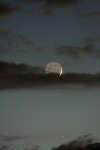 Framed by Clouds
30.04.2009
Last Sunday's fading evening twilight featured a young crescent Moon along the western horizon. The young Moon also shared the sky with the lovely Pleiades star cluster and wandering planet Mercury. Framed by clouds in this serene skyscape from Selsey, UK, a similar twilight scene was visible around the globe.
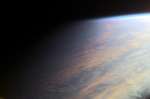 Earth at Twilight
27.12.2007
No sudden, sharp boundary marks the passage of day into night in this gorgeous view of ocean and clouds over our fair planet Earth. Instead, the shadow line or terminator is diffuse and shows the gradual transition to darkness we experience as twilight.
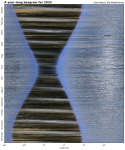 APOD: 2026 June 21 Б Keogram: The Sky in 2025
21.06.2026
What if you could see the entire sky -- all at once -- for an entire year? That, very nearly, is what is pictured here. Every 15 seconds during 2025, an all-sky camera took an image of the sky over the Netherlands.
 APOD: 2026 September 2 Б Solar Eclipses and Culture
2.09.2026
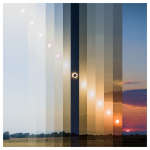
Pretend you have never heard of a solar eclipse. The SunБs behavior has been predictable your whole life. One day, you witness the sky transform as it does in todayБs spliced image spanning two hours of the August 12, 2026 solar eclipse. The Sun disappears, leaving behind a bright, empty ring.
 NGC 3314: When Galaxies Overlap
17.11.2021
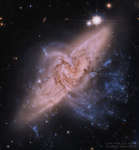
Why doesn't the nearby galaxy create a gravitational lensing effect on the background galaxy? It does, but since both galaxies are so nearby, the angular shift is much smaller than the angular sizes of the galaxies themselves.
|
January February March April May June July August September October |
|||||||||||||||||||||||||||||||||||||||||||||||||