
|
You entered: active Sun
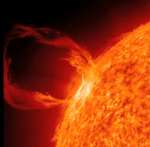 Large Eruptive Prominence Imaged by SDO
10.05.2010
Sometimes part of the Sun can just explode into space. These explosions might occur as powerful solar flares, coronal mass ejections, or comparatively tame eruptive solar prominences. Pictured above is one of the largest solar prominence eruptions yet observed, one associated with a subsequent coronal mass ejection.
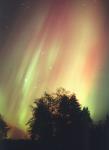 October Skylights
8.11.2000
With brilliant Venus above the western horizon at sunset and Jupiter and Saturn high in the east by early evening, November's night sky is filled with bright planets. October's sky featured bright planets as well and, triggered by the active Sun, some lovely auroral displays.
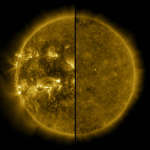 Solar Cycle 25 Begins
17.09.2020
The general trend of monthly sunspot data now confirms that the minimum of the approximately 11 year cycle of solar activity occurred in December 2019, marking the start of Solar Cycle 25. That quiet Sun, at minimum activity, appears on the right of this split hemispherical view.
 The Solar Corona Unwrapped
5.04.2024
Changes in the alluring solar corona are detailed in this creative composite image mapping the dynamic outer atmosphere of the Sun during two separate total solar eclipses. Unwrapped from the complete circle...
 Solar Eclipse
12.06.2025
On April 20, 2023 the shadow of a New Moon raced across planet Earth's southern hemisphere. When viewed along a narrow path that mostly avoided landfall, the Moon in silhouette created a hybrid solar eclipse.
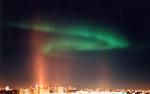 Aurora Over Winnipeg
5.11.2001
What's happening above that city? The city is Winnipeg, Canada, and the phenomenon is aurora. These past few months have been active ones for our Sun, producing several coronal mass ejections (CMEs) of particles that have swept past our Earth and caused many spectacular auroras.
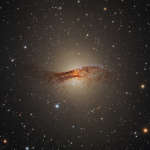 Centaurus A
12.07.2018
Only 11 million light-years away, Centaurus A is the closest active galaxy to planet Earth. Spanning over 60,000 light-years, the peculiar elliptical galaxy also known as NGC 5128, is featured in this sharp telescopic view.
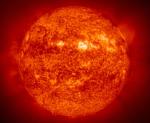 Helios Helium
20.01.2001
This image of the active Sun was made using ultraviolet light emitted by ionized Helium atoms in the Solar chromosphere. Helium was first discovered in the Sun in 1868, its name fittingly derived from from the Greek word Helios, meaning Sun. Credit for the discovery goes to astronomer Joseph Norman Lockyer (born May 17, 1836).
 Ring of Fire over Easter Island
11.10.2024
The second solar eclipse of 2024 began in the Pacific. On October 2nd the Moon's shadow swept from west to east, with an annular eclipse visible along a narrow antumbral shadow path tracking...
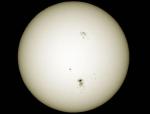 AR 9169: A Large Sunspot
25.09.2000
One of the largest sunspots in recent years is now crossing our Sun. Dominating active region AR 9169, the sunspot is the large dark complex visible below (west) and right of center in the above photograph of our Sun taken last Thursday.
|
January February March April May June July August September |
|||||||||||||||||||||||||||||||||||||||||||||||||