
|
You entered: Voyager 2
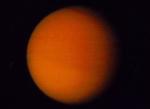 Titan: Saturns Smog Moon
7.02.1999
The largest moon of Saturn is a rare wonder. Titan is the only one of Saturn's moons with an atmosphere, and one of only two moons in the Solar System with this distinction (Neptune's Triton is the other).
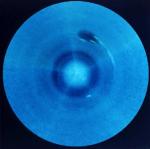 Southern Neptune
29.05.1997
Neptune, the Solar System's outermost gas giant planet, is 30 times farther from the Sun than Earth. Twelve years after a 1977 launch, Voyager 2 flew by Neptune and found surprising activity on a planet that receives only 3 percent as much sunlight as Jupiter.
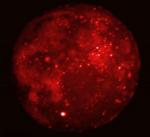 Eclipsed Moon in Infrared
15.09.2001
The total lunar eclipse of September 1996 disappointed many observers in North America who were cursed with cloudy skies. However, the Midcourse Space Experiment (MSX) satellite had a spectacular view from Earth orbit and SPIRIT III, an onboard infrared telescope, was used to repeatedly image the moon during the eclipse.
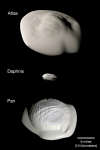 Atlas, Daphnis, and Pan
6.07.2017
Atlas, Daphnis, and Pan are small, inner, ring moons of Saturn, shown at the same scale in this montage of images from the still Saturn-orbiting Cassini spacecraft. In fact, Daphnis was discovered in Cassini images from 2005. Atlas and Pan were first sighted in images from the Voyager 1 and 2 spacecraft.
 New Horizons
22.06.2015
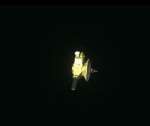
In three weeks, the robotic New Horizons spacecraft will reach Pluto. As the featured video makes clear, though, humanity has been on an unprecedented epoch of robotic exploration of our Solar System's planets for the past half century.
 Southern Neptune
10.07.1999
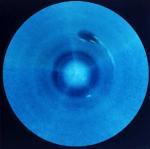
Neptune, the Solar System's outermost gas giant planet, is 30 times farther from the Sun than Earth. Twelve years after a 1977 launch, Voyager 2 flew by Neptune and found surprising activity on a planet that receives only 3 percent as much sunlight as Jupiter.
 Irregular Moons Discovered Around Uranus
3.11.1997
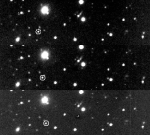
Where did these two irregular moons of Uranus originate? Last week two previously undiscovered moons of the distant gas planet were confirmed, the first in irregular orbits. All fifteen previously known moons of Uranus are 'regular', circling near the planet's equator. Most of these were discovered by the passing Voyager 2 spacecraft in 1986.
 The Clouds of Neptune
7.05.1996
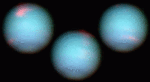
These Hubble Space Telescope (HST) images reveal glimpses of the dynamic atmosphere of Neptune, the Solar System's most distant gas giant planet. The first close-up of Neptune's clouds was provided by NASA's Voyager 2 spacecraft during its August 1989 flyby, giving a tantalizingly brief look.
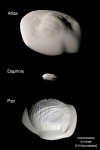 Atlas, Daphnis, and Pan
18.05.2019
Atlas, Daphnis, and Pan are small, inner, ring moons of Saturn. They are shown at the same scale in this montage of images by the Cassini spacecraft that made its grand final orbit of the ringed planet in September 2017. In fact, Daphnis was discovered in Cassini images from 2005.
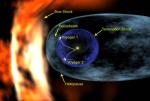 Voyager at 90 AU
20.11.2003
Launched in 1977, Voyager 1 is now about 12 light-hours or 90 astronomical units (AU) from the Sun, making this spacecraft humanity's most distant ambassador to the cosmos. Well beyond the orbits...
|
January February March April May June July August September |
|||||||||||||||||||||||||||||||||||||||||||||||||