
|
You entered: Monoceros
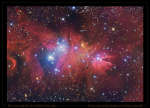 A Fox Fur, a Unicorn, and a Christmas Tree
6.04.2010
What do the following things have in common: a cone, the fur of a fox, and a Christmas tree? Answer: they all occur in the constellation of the unicorn (Monoceros). Pictured above...
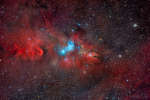 Fox Fur, Unicorn, and Christmas Tree
26.12.2020
Clouds of glowing hydrogen gas fill this colorful skyscape in the faint but fanciful constellation Monoceros, the Unicorn. A star forming region cataloged as NGC 2264, the complex jumble of cosmic gas and dust...
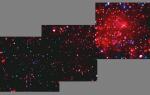 X Ray Stars and Winds in the Rosette Nebula
19.10.2001
This mosaic of x-ray images cuts a swath across the photogenic Rosette Nebula, a stellar nursery 5,000 light-years from Earth in the constellation Monoceros, the Unicorn. Constructed from data recorded by the orbiting...
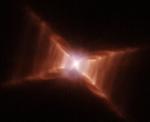 Rungs of the Red Rectangle
13.05.2004
A distinctive X-shape and ladder-like rungs appear in this Hubble Space Telescope image of the intriguing Red Rectangle Nebula. The dusty cosmic cloud was originally identified as a strong source of infrared radiation and is now believed to contain icy dust grains and hydrocarbon molecules formed in the cool outflow from an aging central star.
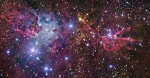 Fox Fur, a Unicorn, and a Christmas Tree
25.12.2008
Clouds of glowing hydrogen gas fill this colorful skyscape in the faint but fanciful constellation Monoceros, the Unicorn. A star forming region cataloged as NGC 2264, the complex jumble of cosmic gas and dust...
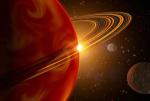 Saturn-Sized Worlds Discovered
30.03.2000
The last decade saw the profound discovery of many worlds beyond our solar system, but none analogs of our home planet Earth. Exploiting precise observational techniques, astronomers inferred the presence of well over two dozen extrasolar planets, most nearly as massive as gas giant Jupiter or more, in close orbits around sun-like stars.
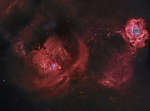 Field of Rosette
14.02.2010
What surrounds the florid Rosette nebula? To better picture this area of the sky, the famous flowery emission nebula on the far right has been captured recently in a deep and dramatic wide field image that features several other sky highlights.
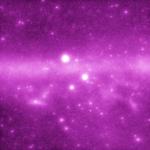 GLAST Gamma Ray Sky Simulation
22.07.2000
What shines in the gamma-ray sky? This simulated image models the intensities of gamma rays with over 40 million times the energy of visible light, and represents how the sky might appear to the Gamma-ray Large Area Space Telescope (GLAST) after its first year in orbit.
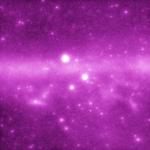 GLAST Gamma Ray Sky Simulation
12.11.1998
This simulated image models the intensities of gamma rays with over 40 million times the energy of visible light, and represents how the sky might appear to the proposed Gamma-ray Large Area Space Telescope (GLAST) after its first year in orbit.
|
January February March April May June July August |
||||||||||||||||||||||||||||||||||||||||||||||||||||||||