
|
You entered: Earth orbit
 When Z is for Mars
15.04.2023
A composite of images captured about a week apart from mid August 2022 through late March 2023, this series traces the retrograde motion of ruddy-colored Mars. Progressing from lower right to upper left Mars...
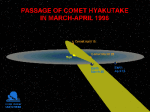 Comet Hyakutake's Orbit
14.03.1996
Where did Comet Hyakutake come from? The orbits of the Earth and this brightening comet are shown in the above diagram. The blue disk is bounded by the circular orbit of the Earth about the central Sun. The comet's path outlines the green shape.
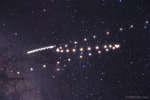 Retrograde Mars and Saturn
15.09.2016
Wandering Mars and Saturn have spent much of this year remarkably close in planet Earth's night sky. In a sequence of exposures spanning mid-December 2015 through the beginning of this week, this composited...
 A Full Moon at Perigee
8.11.2025
What is big, bright, and beautiful, can wear a cape made of clouds, and is at the closest point in its elliptical orbit around planet Earth? A full moon at perigee of course, captured here near moonset in predawn skies on November 5 from Kayseri, Turkiye.
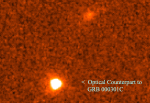 A GRB 000301C Symphony
3.06.2001
Last March, telescopic instruments in Earth and space tracked a tremendous explosion that occurred across the universe. A nearly unprecedented symphony of international observations began abruptly on 2000 March 1 when Earth-orbiting RXTE, Sun-orbiting Ulysses, and asteroid-orbiting NEAR all detected a 10-second burst of high-frequency gamma radiation. Within 48 hours astronomers
 The Moon During a Total Lunar Eclipse
25.05.2021
How does the Moon's appearance change during a total lunar eclipse? The featured time-lapse video was digitally processed to keep the Moon bright and centered during the 5-hour eclipse of 2018 January 31. At first the full moon is visible because only a full moon can undergo a lunar eclipse.
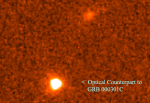 A GRB 000301C Symphony
14.03.2000
Telescopic instruments in Earth and space are still tracking a tremendous explosion that occurred across the universe. A nearly unprecedented symphony of international observations began abruptly on March 1 when Earth-orbiting RXTE, Sun-orbiting Ulysses, and asteroid-orbiting NEAR all detected a 10-second burst of high-frequency gamma radiation.
 Mars in the Loop
30.05.2025
This composite of images spaced a weather-permitting 5 to 9 days apart, from 2024 September 19 (top right) through 2025 May 18 (bottom left), faithfully traces ruddy-colored Mars as it makes a clockwise loop through the constellations Gemini and Cancer in planet Earth's night sky.
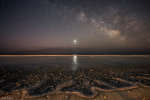 A View from the Zone
7.03.2014
Brilliant Venus and the central Milky Way rise in the early morning hours of March 1 in this sea and skyscape. The scene looks out from a beach at Sea Isle City, New Jersey, USA, planet Earth.
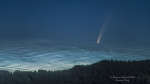 Noctilucent NEOWISE
9.07.2020
These silvery blue waves washing over a tree-lined horizon in the eastern French Alps are noctilucent clouds. From high in planet Earth's mesosphere, they reflect sunlight in this predawn skyscape taken on July 8. This summer, the night-shining clouds are not new to the northern high-latitudes. Comet NEOWISE is though.
|
January February March April May June July August September October |
|||||||||||||||||||||||||||||||||||||||||||||||||