
|
You entered: star cluster
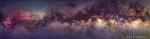 A Milky Way Band
24.02.1999
Most bright stars in our Milky Way Galaxy reside in a disk. Since our Sun also resides in this disk, these stars appear to us as a diffuse band that circles the sky. The above panorama of a southern band of the Milky Way's disk was taken from Australia.
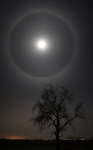 A February Moon Halo
11.02.2012
Lighting the night last Tuesday, February's Full Moon is sometimes called the Snow Moon. But the Moon was not quite full in this mosaicked skyscape recorded on February 2 south of Budapest, Hungary, and there was no snow either.
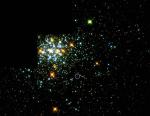 NGC 1818: Pick A Star
31.05.2003
This is NGC 1818, a youthful, glittering cluster of 20,000 stars residing in the Large Magellanic Cloud, 180,000 light-years away. Pick a star. Any star. Astronomers might pick the unassuming bluish-white one (circled) which appears to be a hot newly formed white dwarf star. What makes it so interesting?
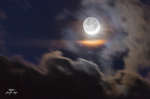 APOD: 2026 April 24 Б Young Moon and Sister Stars
24.04.2026
Sunlit arms of a crescent moon seem to embrace the faint lunar night side in this dramatic celestial scene from planet Earth. The single telephoto exposure tracking the sky was captured on the night of April 19, when a two day old Moon was near perigee in its elliptical orbit.
 Blue Stars and Red Pillars
18.07.1997
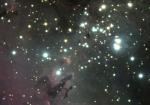
Bright blue stars are still forming in the red pillars of the Eagle Nebula. Made famous by a picture from the Hubble Space Telescope in 1995, the Eagle Nebula shows the dramatic process of star formation. To the upper right of the nebula in the above picture lies the heart of the open cluster M16.
 NGC 6822: Barnard s Galaxy
8.02.2013
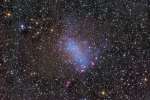
Grand spiral galaxies often seem to get all the glory, flaunting their young, bright, blue star clusters in beautiful, symmetric spiral arms. But small galaxies form stars too, like nearby NGC 6822, also known as Barnard's Galaxy.
 Spitzer s Orion
10.04.2010
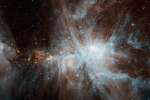
Few cosmic vistas excite the imagination like the Orion Nebula, an immense stellar nursery some 1,500 light-years away. Spanning about 40 light-years across the region, this new infrared image from the Spitzer Space...
 M43: Orion Falls
12.12.2018
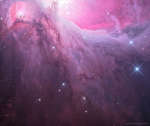
Is there a waterfall in Orion? No, but some of the dust in M43 appears similar to a waterfall on Earth. M43, part of the Orion Molecular Cloud Complex, is the often imaged but rarely mentioned neighbor of the more famous M42.
 NGC 1818: Pick A Star
15.04.1998
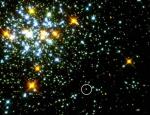
This is NGC 1818, a youthful, glittering cluster of 20,000 stars residing in the Large Magellanic Cloud, 164,000 light-years away. Pick a star. Any star. Astronomers might pick the unassuming bluish-white one (circled) which appears to be a hot newly formed white dwarf star. What makes it so interesting?
 The Antennae Galaxies in Collision
16.03.2014
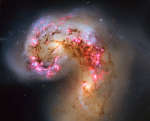
Two galaxies are squaring off in Corvus and here are the latest pictures. When two galaxies collide, the stars that compose them usually do not. That's because galaxies are mostly empty space and, however bright, stars only take up only a small amount of that space.
|
January February March April May |
|||||||||||||||||||||||||||||||||||||||||||||||||