
|
You entered: wind
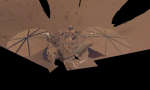 InSight's Final Selfie
4.11.2022
The Mars InSight lander returned its first image from the Red Planet's flat, equatorial Elysium Planitia after a successful touchdown on November 26, 2018. The history making mission to explore the martian Interior using Seismic investigations, geodesy, and heat transport has been operating for over 1,400 martian days or sols.
 APOD: 2023 May 2 Б Flat Rock Hills on Mars
2.05.2023
Why are there so many flat rocks on Mars? Some views of plains and hills on Mars show many rocks that are unusually flat when compared to rocks on Earth. One reason for this is a process that is common to both Mars and Earth: erosion.
 M100: A Grand Design Spiral Galaxy
2.05.2024
Majestic on a truly cosmic scale, M100 is appropriately known as a grand design spiral galaxy. The large galaxy of over 100 billion stars has well-defined spiral arms, similar to our own Milky Way.
 APOD: 2025 January 26 Б The Many Tails of Comet G3 ATLAS
26.01.2025
Why does this comet have so many tails? C/2024 G3 (ATLAS) has developed several long and intricate tails visible from Earth's southern hemisphere over the past two weeks. Many observers reported seeing the impressive comet without any optical aid above the western horizon just after sunset.
 APOD: 2025 December 17 Б W5: The Soul Nebula
17.12.2025
Stars are forming in the Soul of the Queen of Aethopia. More specifically, a large star forming region called the Soul Nebula can be found in the direction of the constellation Cassiopeia, whom Greek mythology credits as the vain wife of a King who long ago ruled lands surrounding the upper Nile river.
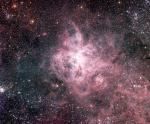 The Tarantula Zone
13.06.2002
The Tarantula Nebula is more than 1,000 light-years across - a giant emission nebula within our neighboring galaxy the Large Magellanic Cloud. Inside this cosmic arachnid lies a central young cluster of massive stars, cataloged as R136, whose intense radiation and strong winds have helped energize the nebular glow and shape the spidery filaments.
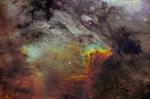 IC 5067: A Piece of the Pelican
19.10.2007
(xxxedit and linkxxx) The prominent ridge of emission featured in this dramatic skyscape is cataloged as IC 5067. Part of a larger emission nebula with a distinctive shape, popularly called The Pelican Nebula, the ridge spans about 10 light-years following the curve of the cosmic pelican's head and neck.
 Cepheus: Trunk to Bubble
9.09.2010
Star clusters, glowing nebulae and dark dust clouds abound in Cepheus, royal constellation of the northern hemisphere. You can follow them in amazing detail across this broad skyscape, a mosaic of telescopic images spanning about 17 degrees. Beginning at the lower left, the large emission nebula is cataloged as IC 1396.
 The Upper Michigan Blizzard of 1938
22.01.2014
Yes, but can your blizzard do this? In Upper Michigan's Storm of the Century in 1938, some snow drifts reached the level of utility poles. Nearly a meter of new and unexpected snow fell over two days in a storm that started 76 years ago tomorrow.
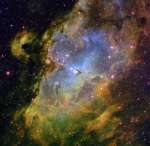 Inside the Eagle Nebula
16.02.2014
From afar, the whole thing looks like an Eagle. A closer look at the Eagle Nebula, however, shows the bright region is actually a window into the center of a larger dark shell of dust. Through this window, a brightly-lit workshop appears where a whole open cluster of stars is being formed.
|
January February March April May June |
|||||||||||||||||||||||||||||||||||||||||||||||||