
|
You entered: dust cloud
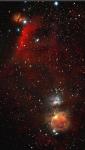 Orion Nebulosities
30.05.2002
Adrift 1,500 light-years away in one of the night sky's most recognizable constellations, the glowing Orion Nebula and the dark Horsehead Nebula are contrasting cosmic vistas. They both appear in this stunning composite color photograph along with other nebulosities as part of the giant Orion Molecular Cloud complex, itself hundreds of light-years across.
 Young Star Cluster NGC 346
2.05.2025
The most massive young star cluster in the Small Magellanic Cloud is NGC 346, embedded in our small satellite galaxy's largest star forming region some 210,000 light-years distant. Of course the massive stars of NGC 346 are short lived, but very energetic.
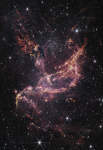 Young Star Cluster NGC 346
13.01.2023
The most massive young star cluster in the Small Magellanic Cloud is NGC 346, embedded in our small satellite galaxy's largest star forming region some 210,000 light-years distant. Of course the massive stars of NGC 346 are short lived, but very energetic.
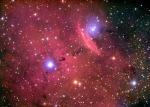 Emission and Reflection in NGC 6559
23.10.2001
Bright gas and dark dust permeate the space between stars in a nebula known as NGC 6559. The gas, primarily hydrogen, is responsible for the diffuse red glow of the emission nebula. As energetic...
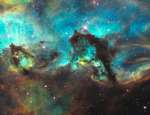 The Seahorse of the Large Magellanic Cloud
29.11.2014
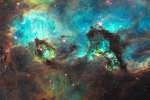
It may look like a grazing seahorse, but the dark object toward the image right is actually a pillar of smoky dust about 20 light years long. The curiously-shaped dust structure occurs in our neighboring Large Magellanic Cloud, in a star forming region very near the expansive Tarantula Nebula.
 Hydrogen Trifid
28.08.1998
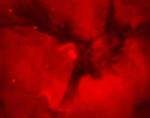
Clouds of glowing hydrogen gas mingle with dark dust lanes in the Trifid Nebula, a star forming region in the constellation Sagittarius. In this and other similar emission nebulae, energetic ultraviolet light from an embedded hot young star strips electrons from the surrounding hydrogen atoms.
 The Seahorse of the Large Magellanic Cloud
23.03.2009
To some it may look to some like a big space monster, but it is more big than monster. To others it may look like a grazing seahorse, but the dark object toward the image right is actually an inanimate pillar of smoky dust about 20 light years long.
 In the Center of NGC 6559
29.06.2004
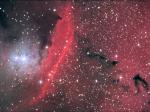
Bright gas and dark dust permeate the space between stars in the center of a nebula known as NGC 6559. The gas, primarily hydrogen, is responsible for the diffuse red glow of the emission nebula.
 NGC4039: Starbirth and Galaxy Death
6.05.1997
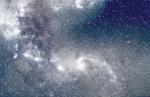
Do star clusters form when galaxies collide? Quite possibly, according to Hubble Space Telescope observations of the "Antennae", two galaxies thought to be in the early stages of a collision.
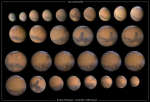 Changes in Angular Mars
14.07.2008
Does Mars always appear the same? No. As both Earth and Mars orbit the Sun, the apparent angular size of Mars changes as viewed from the Earth. Pictured above from Enschede, Holland, Mars was captured in 2007 and 2008 with 30 separate images, all taken with the same magnification.
|
January February March April May June July August September |
|||||||||||||||||||||||||||||||||||||||||||||||||