
|
You entered: dust
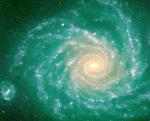 Spiral Galaxy NGC 1232
22.05.2001
Galaxies are fascinating not only for what is visible, but for what is invisible. Grand spiral galaxy NGC 1232, captured in detail by one of the new Very Large Telescopes, is a good example.
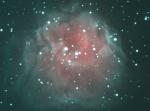 Sharpless 212 in Hydrogen and Sulfur
18.12.2001
Where do the most massive stars form? Observational evidence indicates that the outskirts of developing open clusters of stars are primary locations. Pictured above is one such open cluster: Sharpless 212. Visible in the image center are massive stars in the open cluster.
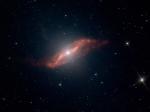 The Galaxy Within Centaurus A
4.03.2006
Peering deep inside Centaurus A, the closest active galaxy to Earth, the Spitzer Space Telescope's penetrating infrared cameras recorded this startling vista in February 2004. About 1,000 light-years across, the twisted cosmic...
 Rings Around Beta Pictoris
8.02.2000
An unusual dust disk surrounds nearby star Beta Pictoris. Discovered in 1983, astronomers are still learning just how unusual this disk is. Recent images and computer simulations indicate that the disk contains several elliptical dust rings larger than our own Solar System.
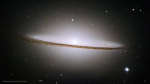 The Sombrero Galaxy from Hubble
26.07.2015
Why does the Sombrero Galaxy look like a hat? Reasons include the Sombrero's unusually large and extended central bulge of stars, and dark prominent dust lanes that appear in a disk that we see nearly edge-on. Billions of old stars cause the diffuse glow of the extended central bulge.
 APOD: 2023 November 20 Б The Horsehead Nebula
20.11.2023
Sculpted by stellar winds and radiation, a magnificent interstellar dust cloud by chance has assumed this recognizable shape. Fittingly named the Horsehead Nebula, it is some 1,500 light-years distant, embedded in the vast Orion cloud complex.
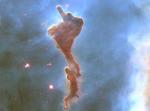 Disappearing Clouds in Carina
30.06.2003
This dense cloud of gas and dust is being deleted. Likely, within a few million years, the intense light from bright stars will have boiled it away completely. Stars not yet formed in the molecular cloud's interior will then stop growing.
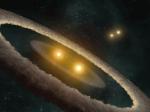 The Four Suns of HD 98800
30.07.2007
How would it look to have four suns in the sky? Planets of the HD 98800 system, if they exist, would experience such a view. HD 98800 is a multiple star system about 150 light years from Earth -- right in our section of the Milky Way Galaxy.
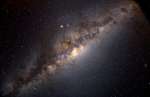 The Milky Way at 5000 Meters
4.01.2008
Climb up to 5000 meters (16,500 feet) above sea level, near Cerro Chajnantor in the northern Chilean Andes, and your night sky could encompass this cosmic vista. Recorded from that high and dry locale, the spectacular fish-eye image features the myriad stars and sprawling dust clouds of our Milky Way Galaxy.
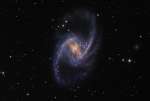 NGC 1365: Majestic Spiral with Supernova
24.11.2012
Barred spiral galaxy NGC 1365 is truly a majestic island universe some 200,000 light-years across. Located a mere 60 million light-years away toward the chemical constellation Fornax, NGC 1365 is a dominant member of the well-studied Fornax galaxy cluster.
|
January February March April May June July August September |
|||||||||||||||||||||||||||||||||||||||||||||||||