
|
You entered: dark
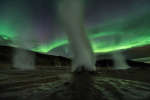 Night on a Spooky Planet
30.10.2022
What spooky planet is this? Planet Earth of course, on a dark and stormy night in 2013 at Hverir, a geothermally active area along the volcanic landscape in northeastern Iceland. Triggered by solar activity, geomagnetic storms produced the auroral display in the starry night sky.
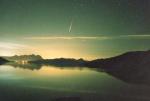 Dawn of the Leonids
22.12.1998
Many of the 1998 Leonid shower meteors were so bright they could be seen even during sunrise. The above photograph was taken near the dawn of November 16 close to Hong Kong, China. However, most meteors are fainter and are not associated with any particular meteor shower.
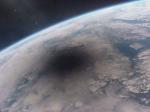 Looking Back on an Eclipsed Earth
30.08.1999
Here is what the Earth looks like during a solar eclipse. The shadow of the Moon can be seen darkening part of Earth. This shadow moves across the Earth at nearly 2000 kilometers per hour.
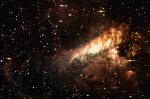 M17: The Omega Nebula
26.01.1999
The Omega Nebula contains glowing gas, dark dust, and some unusually massive stars. Also known as the M17 and the Swan Nebula, the Omega Nebula is about 5000 light-years away, 20 light-years across, and visible with binoculars in the constellation of Sagittarius.
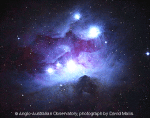 NGC 1977: Blue Reflection Nebula in Orion
1.02.1998
The Orion Nebula is visible to the unaided eye as a fuzzy patch near the famous belt of three stars in the constellation Orion. The above picture captures a part of the Orion Nebula that primarily reflects light from bright Orion stars.
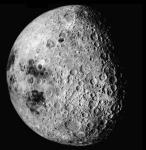 Far Side of the Moon
8.10.1998
Locked in synchronous rotation, the Moon always presents its well-known near side to Earth. But from lunar orbit, Apollo astronauts also grew to know the Moon's far side. This sharp picture from Apollo...
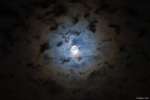 Halloween s Moon
5.11.2009
Illuminating the landscape all through the night of November 2nd, this week's bright Full Moon was known in the northern hemisphere as a Hunter's Moon. But this dramatic view of the shining lunar orb, from Sobreda, Portugal, was captured just a few nights earlier, on Halloween.
 Eclipse in Seven
11.04.2024
Start at the upper left above and you can follow the progress of April 8's total eclipse of the Sun in seven sharp, separate exposures. The image sequence was recorded with a telescope and camera located within the narrow path of totality as the Moon's shadow swept across Newport, Vermont, USA.
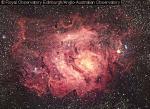 M8: The Lagoon Nebula
7.07.1998
The bright Lagoon Nebula is home to a diverse array of astronomical objects. Particularly interesting sources include a bright open cluster of stars and several energetic star-forming regions. The general red glow is caused by luminous hydrogen gas, while the dark filaments are caused by absorption by dense lanes of dust.
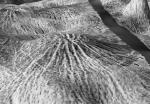 One Hundred Kilometer Terrain on Venus
7.05.2001
Even the hot and cracked surface of Venus has rolling hills. Although never actually photographed from up-close, images of the Venusian surface like that shown above have been constructed in recent years by digitally merging distant photographs with height-sensitive radar. Isolated above is a 100-kilometer wide swath inside a volcanic region known as Yavine Corona.
|
January February March April May June July August September |
|||||||||||||||||||||||||||||||||||||||||||||||||