
|
You entered: Moon
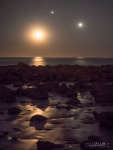 Triple Conjunction Over Galician National Park
24.06.2015
What are those bright objects hovering over the horizon? Planets -- and the Moon. First out, the horizon featured is a shoreline of the Atlantic Ocean that occurs at the Galicia National Park in northern Spain. Next furthest out, on the left, is the Moon.
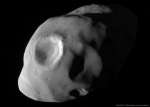 Pandora Close up at Saturn
3.01.2017
What do the craters of Saturn's small moon Pandora look like up close? To help find out, NASA sent the robotic Cassini spacecraft, now orbiting Saturn, past the unusual moon two weeks ago. The highest resolution image of Pandora ever taken was then captured from about 40,000 kilometers out and is featured here.
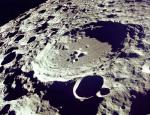 Lunar Farside from Apollo 11
12.03.2003
The far side of the Moon is rough and filled with craters. By comparison, the near side of the Moon, the side we always see, is relatively smooth. Since the Moon is rotation locked to always point the same side toward Earth, humanity has only glimpsed the lunar farside recently -- last century.
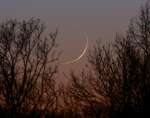 A Twilight Occultation
10.12.2010
A thin, one day old crescent Moon hugged the western horizon after sunset on Monday, December 6. The Moon also occulted or passed in front of Mars. But only some well-placed skygazers along a band through North America were able to catch this lunar occultation's final act in fading twilight.
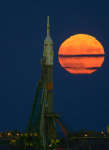 Soyuz vs Supermoon
17.11.2016
Faster than a speeding bullet, more powerful than a locomotive, and able to leap tall buildings in a single bound, this Soyuz rocket stands on the launch pad at Baikonur Cosmodrome in Kazakhstan on November 14.
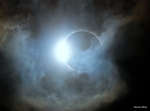 Diamond in the Sky
18.12.2020
When the shadow of the Moon raced across planet Earth's southern hemisphere on December 14, sky watchers along the shadow's dark central path were treated to the only total solar eclipse of 2020. During the New Moon's shadow play this glistening diamond ring was seen for a moment, even in cloudy skies.
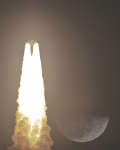 Artemis 1 Moonshot
19.11.2022
When the Artemis 1 mission's Orion spacecraft makes its November 21 powered flyby of the Moon, denizens of planet Earth will see the Moon in a waning crescent phase. The spacecraft will approach...
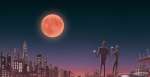 Tonight: A Supermoon Lunar Eclipse
27.09.2015
Tonight a bright full Moon will fade to red. Tonight's moon will be particularly bright because it is reaching its fully lit phase when it is relatively close to the Earth in its elliptical orbit.
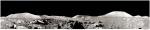 Apollo 17 Panorama: Astronaut Running
10.12.2006
What would it be like to explore the surface of another world? In 1972 during the Apollo 17 mission, astronaut Harrison Schmitt found out first hand. In this case, the world was Earth's own Moon.
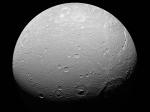 APOD: 2007 August 1- Unusual Cratering on Saturns Dione
1.08.2007
Why does one half of Dione have more craters than the other? Start with the fact that Saturn's moon Dione always has one side that faces Saturn, and always has one side that faces away. This is similar to Earth's Moon.
|
January February March April May June July August September October |
|||||||||||||||||||||||||||||||||||||||||||||||||