
|
You entered: space
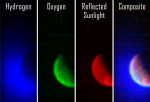 MAVEN at Mars
26.09.2014
Launched on November 18, 2013, the MAVEN (Mars Atmosphere and Volatile EvolutioN) spacecraft completed its interplanetary voyage September 21, captured into a wide, elliptical orbit around Mars. MAVEN's imaging ultraviolet spectrograph has already...
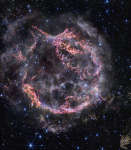 Supernova Remnant Cassiopeia A
6.02.2026
Massive stars in our Milky Way Galaxy live spectacular lives. Collapsing from vast cosmic clouds, their nuclear furnaces ignite and create heavy elements in their cores. After only a few million years for the most massive stars, the enriched material is blasted back into interstellar space where star formation can begin anew.
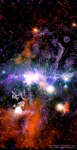 The Galactic Center in Stars, Gas, and Magnetism
2.06.2021
What's going on near the center of our galaxy? To help find out, a newly detailed panorama has been composed that explores regions just above and below the galactic plane in radio and X-ray light.
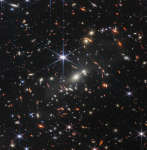 Webb s First Deep Field
13.07.2022
This is the deepest, sharpest infrared image of the cosmos so far. The view of the early Universe toward the southern constellation Volans was achieved in 12.5 hours of exposure with the NIRCam instrument on the James Webb Space Telescope. Of course the stars with six visible spikes are well within our own Milky Way.
 APOD: 2025 November 11 Б Jupiter in Ultraviolet from Hubble
11.11.2025
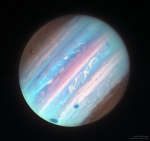
Jupiter looks a bit different in ultraviolet light. To better interpret Jupiter's cloud motions and to help NASA's robotic Juno spacecraft understand the planetary context of the small fields that it sees, the Hubble Space Telescope was being directed to regularly image the entire Jovian giant.
 Blue Stragglers in NGC 6397
8.08.2003
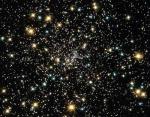
In our neck of the Galaxy stars are too far apart to be in danger of colliding, but in the dense cores of globular star clusters star collisions may be relatively common. In fact...
 The Hubble Ultra Deep Field in Light and Sound
2.08.2021
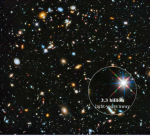
Have you heard about the Hubble Ultra-Deep Field? Either way, you've likely not heard about it like this -- please run your cursor over the featured image and listen! The Hubble Ultra-Deep Field (HUDF)...
 NGC 1333: Stellar Nursery in Perseus
22.04.2023
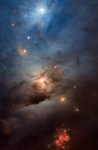
In visible light NGC 1333 is seen as a reflection nebula, dominated by bluish hues characteristic of starlight reflected by interstellar dust. A mere 1,000 light-years distant toward the heroic constellation Perseus, it lies at the edge of a large, star-forming molecular cloud.
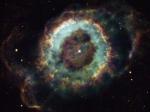 NGC 6369: The Little Ghost Nebula
7.02.2004
This pretty planetary nebula, cataloged as NGC 6369, was discovered by 18th century astronomer William Herschel as he used a telescope to explore the medicinal constellation Ophiucus. Round and planet-shaped, the nebula is also relatively faint and has acquired the popular moniker of Little Ghost Nebula.
 APOD: 2024 January 7 Б The Cats Eye Nebula in Optical and X-ray
7.01.2024
To some it looks like a cat's eye. To others, perhaps like a giant cosmic conch shell. It is actually one of the brightest and most highly detailed planetary nebula known, composed of gas expelled in the brief yet glorious phase near the end of life of a Sun-like star.
|
January February March April May June July August September |
|||||||||||||||||||||||||||||||||||||||||||||||||