
|
You entered: sky
 A Solstice Moon
29.06.2024
Rising opposite the setting Sun, June's Full Moon occurred within about 28 hours of the solstice. The Moon stays close to the Sun's path along the ecliptic plane and so while the solstice Sun climbed high in daytime skies, June's Full Moon remained low that night as seen from northern latitudes.
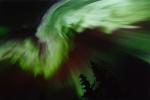 Aurora Alaskan Style
29.03.2001
Have you checked the space weather report lately? With a coronal mass ejection (CME) headed our way and an immense sunspot group tracking across the solar photosphere, skygazers should be on the alert.
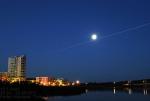 Moons and Bright Mars
1.08.2003
In this serene view, the moons of Earth along with the bright planet Mars shine above the city of Turku near the southwestern tip of Finland. Of course Earth's large natural satellite, the Moon, at a distance of 400,000 kilometers, is by far the brightest object in this sky.
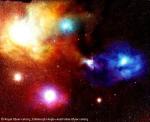 Antares and Rho Ophiuchi
22.09.1997
Why is the sky near Antares and Rho Ophiuchi so colorful? The colors result from a mixture of objects and processes. Fine dust illuminated from the front by starlight produces blue reflection nebulae. Gaseous clouds whose atoms are excited by ultraviolet starlight produce reddish emission nebulae. Backlit dust clouds block starlight and so appear dark.
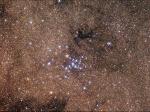 The M7 Open Star Cluster in Scorpius
6.04.2005
M7 is one of the most prominent open clusters of stars on the sky. The cluster, dominated by bright blue stars, can be seen with the naked eye in a dark sky in the tail of the constellation of Scorpius.
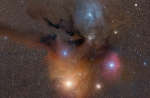 Colorful Clouds Near Rho Ophiuchi
28.08.2012
Why is the sky near Antares and Rho Ophiuchi so colorful? The colors result from a mixture of objects and processes. Fine dust illuminated from the front by starlight produces blue reflection nebulae. Gaseous clouds whose atoms are excited by ultraviolet starlight produce reddish emission nebulae. Backlit dust clouds block starlight and so appear dark.
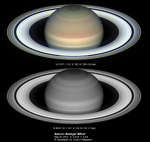 Saturn at Opposition
29.05.2015
Telescopic observers on Earth have been treated to spectacular views of Saturn lately as the ringed planet reached its 2015 opposition on May 23 at 0200 UT. Of course opposition means opposite the Sun in Earth's sky. So near opposition Saturn is up all night, at its closest and brightest for the year.
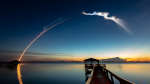 Atlas at Dawn
9.08.2019
This single, 251-second long exposure follows the early flight of an Atlas V rocket on August 8, streaking eastward toward the dawn from Cape Canaveral Air Force Station, planet Earth. The launch of the United Launch Alliance rocket was at 6:13am local time.
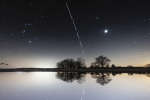 Reflecting the International Space Station
28.05.2020
Still bathed in sunlight, the International Space Station arced through the evening sky over lake Wulfsahl-Gusborn in northern Germany, just after sunset on March 25. The familiar constellation of Orion can be seen left of the trail of the orbital station's bright passage.
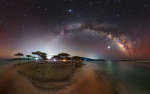 Light and Glory over Crete
16.11.2020
The month was July, the place was the Greek island of Crete, and the sky was spectacular. Of course there were the usual stars like Polaris, Vega, and Antares -- and that common asterism everyone knows: the Big Dipper. But this sky was just getting started.
|
January February March April May June July August September October |
|||||||||||||||||||||||||||||||||||||||||||||||||