
|
You entered: hot star
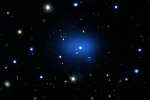 JKCS041: The Farthest Galaxy Cluster Yet Measured
28.10.2009
What if we could see back to the beginning of the universe? We can -- since it takes the age of the universe for light to cross the universe. Peering at distant objects, therefore, tells us about how the universe used to be, even near its beginning.
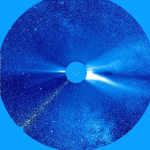 Solar Wind And Milky Way
4.03.1997
The Sun is bright, so bright that it overwhelms the light from other stars even for most satellite-borne telescopes. But LASCO, a coronograph onboard the space-based SOHO Observatory, uses occulting disks to block the intense solar light and examine the tenuous, hot gases millions of miles above the Sun's surface.
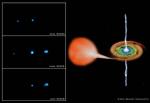 The X Ray Jets of XTE J1550
8.10.2002
The motion of ultra-fast jets shooting out from a candidate black hole star system have now been documented by observations from the orbiting Chandra X-ray Observatory. In 1998, X-ray source XTE J1550-564 underwent a tremendous outburst.
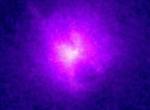 Hot Gas In Hydra A
17.12.1999
The Hydra A galaxy cluster is really big. In fact, such clusters of galaxies are the largest gravitationally bound objects in the Universe. But individual galaxies are too cool to be recorded in this false-color Chandra Observatory X-ray image which shows only the 40 million degree gas that permeates the Hydra A cluster.
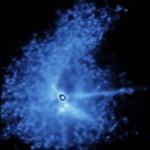 The T Tauri Star Forming System
4.06.2001
What did the Sun look like before there were planets? A prototype laboratory for the formation of low mass stars like our Sun is the T Tauri system, one of the brighter star systems toward the constellation of Taurus. In young systems, gravity causes a gas cloud to condense.
 Z Machine Sets Unexpected Earth Temperature Record
13.03.2006
Why is this plasma so hot? Physicists aren't sure. What is known for sure is that the Z Machine running at Sandia National Laboratories created a plasma that was unexpectedly hot. The plasma...
 Supernova Remnant Cassiopeia A
17.01.2025
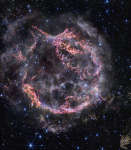
Massive stars in our Milky Way Galaxy live spectacular lives. Collapsing from vast cosmic clouds, their nuclear furnaces ignite and create heavy elements in their cores. After only a few million years for the most massive stars, the enriched material is blasted back into interstellar space where star formation can begin anew.
 Supernova Remnant Cassiopeia A
6.02.2026
Massive stars in our Milky Way Galaxy live spectacular lives. Collapsing from vast cosmic clouds, their nuclear furnaces ignite and create heavy elements in their cores. After only a few million years for the most massive stars, the enriched material is blasted back into interstellar space where star formation can begin anew.
 NGC 4631: The Whale Galaxy
3.06.2016
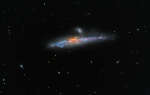
NGC 4631 is a big beautiful spiral galaxy. Seen edge-on, it lies only 25 million light-years away in the well-trained northern constellation Canes Venatici. The galaxy's slightly distorted wedge shape suggests to some a cosmic herring and to others its popular moniker, The Whale Galaxy.
 Spiral Galaxy NGC 2841
3.03.2022
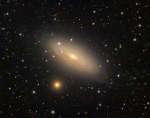
A mere 46 million light-years distant, spiral galaxy NGC 2841 can be found in the northern constellation of Ursa Major. This deep view of the gorgeous island universe was captured during 32 clear nights in November, December 2021 and January 2022. It shows off a striking yellow nucleus, galactic disk, and faint outer regions.
|
January February March April May June July August September |
|||||||||||||||||||||||||||||||||||||||||||||||||