
|
You entered: dark cloud
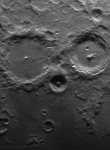 Alphonsus and Arzachel
17.07.2021
Point your telescope at tonight's first quarter Moon. Along the terminator, the shadow line between night and day, you might find these two large craters staring back at you with an owlish gaze. Alphonsus (left) and Arzachel are ancient impact craters on the north eastern shores of Mare Nubium, the lunar Sea of Clouds.
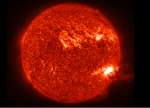 The Sun Unleashed: Monster Filament in Ultraviolet
9.04.2018
One of the most spectacular solar sights is an explosive flare. In 2011 June, the Sun unleashed somewhat impressive, medium-sized solar flare as rotation carried active regions of sunpots toward the solar limb. That...
 Stars and Planets over Portugal
18.04.2022
The mission was to document night-flying birds -- but it ended up also documenting a beautiful sky. The featured wide-angle mosaic was taken over the steppe golden fields in Mцrtola, Portugal in 2020. From such a dark location, an immediately-evident breathtaking glow arched over the night sky: the central band of our Milky Way galaxy.
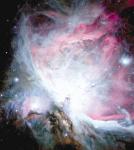 The Orion Nebula from CFHT
15.03.2004
Few astronomical sights excite the imagination like the nearby stellar nursery known as the Orion Nebula. The Nebula's glowing gas surrounds hot young stars at the edge of an immense interstellar molecular cloud only 1500 light-years away.
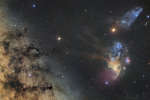 Saturn and Mars visit Milky Way Star Clouds
10.05.2016
Planets, stars, nebulas and a galaxy -- this impressive image has them all. Closest to home are the two planets Mars (right) and Saturn (center), visible as the two bright orange spots in the upper half of the featured image.
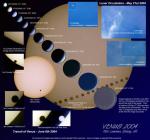 A Rare Annular Venusian Solar Eclipse
15.06.2004
An unusual type of solar eclipse occurred last week. Usually it is the Earth's Moon that eclipses the Sun. Last week, for the first time in over 100 years, the planet Venus took a turn.
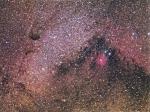 M24: A Sagittarius Starscape
21.09.2004
Many vast star fields in the plane of our Milky Way Galaxy are rich in clouds of dust, and gas. First and foremost, visible in the above picture are millions of stars, many of which are similar to our Sun.
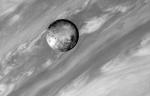 5 Million Miles From Io
11.03.1999
Twenty years ago this month, NASA's Voyager 1 spacecraft flew past Jupiter and its moons. This sharp picture of moon Io against a background of gas giant Jupiter's diffuse swirling cloud bands was recorded by Voyager's camera from a distance of about 5 million miles.
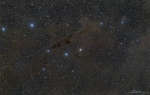 Barnard 228: The Dark Wolf Nebula in Lupus
26.07.2018
These dark markings on the sky can just be found in silhouette against a rich, luminous background of stars. Seen toward the southern constellation of Lupus the Wolf, the dusty, obscuring clouds are part of the Lupus Molecular Cloud some 500 light-years distant.
 A Total Solar Eclipse over Wyoming
22.08.2017
Will the sky be clear enough to see the eclipse? This question was on the minds of many people attempting to view yesterday's solar eclipse. The path of total darkness crossed the mainland...
|
January February March April May June July August September |
|||||||||||||||||||||||||||||||||||||||||||||||||