
|
You entered: comet
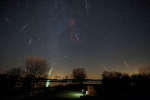 Leonids and Friends
20.11.2015
Leonid meteors rained down on planet Earth this week, the annual shower of dusty debris from the orbit of Comet 55P/Tempel-Tuttle. Leonids streak through this composite night skyview from a backyard observatory in southern Ontario.
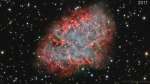 M1: The Incredible Expanding Crab
4.01.2018
The Crab Nebula is cataloged as M1, the first on Charles Messier's famous list of things which are not comets. In fact, the Crab is now known to be a supernova remnant, an expanding cloud of debris from the explosion of a massive star.
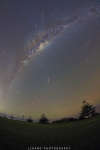 Halley Dust and Milky Way
10.05.2019
Grains of cosmic dust streaked through the mostly moonless night skies of May 7. Swept up as planet Earth plowed through the debris streams left behind by periodic Comet Halley, the annual meteor shower is known as the Eta Aquarids.
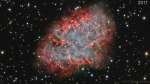 APOD: 2023 March 20 Б M1: The Expanding Crab Nebula
20.03.2023
Are your eyes good enough to see the Crab Nebula expand? The Crab Nebula is cataloged as M1, the first on Charles Messier's famous list of things which are not comets. In fact...
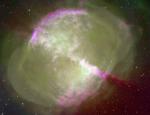 M27: The Dumbbell Nebula
6.03.2001
The first hint of what will become of our Sun was discovered inadvertently in 1764. At that time, Charles Messier was compiling a list of "annoying" diffuse objects not to be confused with "interesting" comets.
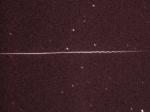 A Twisted Meteor Train
2.02.2005
Did this meteor leave a twisting path? Evidently. Meteor trains that twist noticeably are rare - and even more rarely photographed - but have been noted before. The underlying reason for unusual meteors trains is that many meteors are markedly non-spherical in shape and non-uniform in composition.
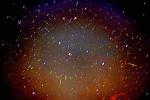 A Leonids Meteor Storm in 1999
24.11.1999
The 1999 Leonids meteor shower was not equally good for everybody. Only observers in Europe and the Middle East with clear skies near 2 am (UTC) on 1999 November 18 saw rates shoot up to a meteor every few seconds.
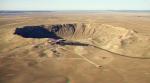 3D Barringer Meteorite Crater
23.06.2007
Baringer Meteorite Crater, near Winslow, Arizona, is one of the best known impact craters on planet Earth. View this color stereo anaglyph with red/blue glasses to get a dramatic sense of the crater's dimensions -- one mile wide, and up to 570 feet deep.
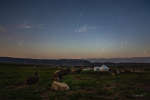 The Perseids and the Plough
15.08.2019
Despite interfering moonlight, many denizens of planet Earth were able to watch this year's Perseid meteor shower. This pastoral scene includes local skygazers admiring the shower's brief, heavenly flashes in predawn hours near peak activity on August 13 from Nalati Grassland in Xinjiang, China.
 M1: The Incredible Expanding Crab
15.11.2023
Cataloged as M1, the Crab Nebula is the first on Charles Messier's famous list of things which are not comets. In fact, the Crab Nebula is now known to be a supernova remnant, an expanding cloud of debris from the death explosion of a massive star.
|
January February March April May June July August September |
|||||||||||||||||||||||||||||||||||||||||||||||||