
|
You entered: star system
 A Message From Earth
13.03.2005
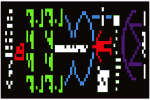
What are these Earthlings trying to tell us? The above message was broadcast from Earth towards the globular star cluster M13 in 1974. During the dedication of the Arecibo Observatory - still the largest radio telescope in the world - a string of 1's and 0's representing the above diagram was sent.
 A Message From Earth
19.02.2012
What are these Earthlings trying to tell us? The above message was broadcast from Earth towards the globular star cluster M13 in 1974. During the dedication of the Arecibo Observatory - still the largest single radio telescope in the world - a string of 1's and 0's representing the above diagram was sent.
 NGC 5078 and Friends
25.05.2016
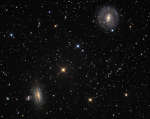
This sharp telescopic field of view holds two bright galaxies. Barred spiral NGC 5101 (top right) and nearly edge-on system NGC 5078 are separated on the sky by about 0.5 degrees or about the apparent width of a full moon.
 M51: The Whirlpool Galaxy
2.09.2022
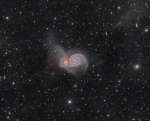
Find the Big Dipper and follow the handle away from the dipper's bowl until you get to the last bright star. Then, just slide your telescope a little south and west and you'll come upon this stunning pair of interacting galaxies, the 51st entry in Charles Messier's famous catalog.
 A Message From Earth
23.01.2000
What are these Earthlings trying to tell us? The above message was broadcast from Earth towards the globular star cluster M13 in 1974. During the dedication of the Arecibo Observatory - still the largest radio telescope in the world - a string of 1's and 0's representing the
 A Comet and a Crab
22.10.2021
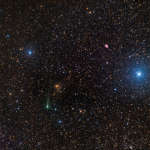
This pretty field of view spans over 2 degrees or 4 full moons on the sky, filled with stars toward the constellation Taurus, the Bull. Above and right of center in the frame you can spot the faint fuzzy reddish appearance of Messier 1 (M1), also known as the Crab Nebula.
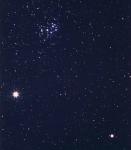 Jupiter, Saturn and Messier 45
22.03.2001
Brilliant Venus falls out of the evening sky as March ends, but Jupiter and Saturn remain well up above the western horizon. Jupiter blazes forth above and to the left of a slightly fainter Saturn in this telephoto picture taken on January 19th.
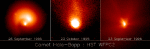 Comet Hale-Bopp Inbound
19.12.1996
Headed toward the inner Solar System, the much anticipated Comet Hale-Bopp has promised to put on a big show next spring. The comet's apparent brightness is currently approaching 4th magnitude and its inbound journey has been closely followed by many observers.
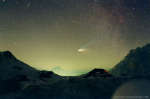 Comet Hale Bopp Over Val Parola Pass
9.04.2017
Comet Hale-Bopp, the Great Comet of 1997, became much brighter than any surrounding stars. It was seen even over bright city lights. Away from city lights, however, it put on quite a spectacular show. Here Comet Hale-Bopp was photographed above Val Parola Pass in the Dolomite mountains surrounding Cortina d'Ampezzo, Italy.
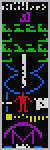 A Message from Earth
3.05.2020
What are these Earthlings trying to tell us? The featured message was broadcast from Earth towards the globular star cluster M13 in 1974. During the dedication of the Arecibo Observatory - still one of the largest single radio telescopes in the world - a string of 1's and 0's representing the diagram was sent.
|
January February March April May June July August September |
|||||||||||||||||||||||||||||||||||||||||||||||||