
|
You entered: star cluster
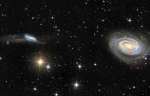 Arp 159 and NGC 4725
3.09.2015
Pointy stars and peculiar galaxies span this cosmic snapshot, a telescopic view toward the well-groomed constellation Coma Berenices. Bright enough to show off diffraction spikes, the stars are in the foreground of the scene, well within our own Milky Way. But the two prominent galaxies lie far beyond our own, some 41 million light-years distant.
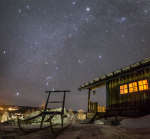 Cabin Under the Stars
17.01.2019
Gocka's, a family nickname for the mountain cabin, and a wooden sled from a generation past stand quietly under the stars. The single exposure image was taken on January 6 from Tanndalen Sweden to evoke a simple visual experience of the dark mountain skies.
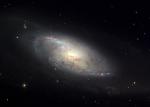 M106 in Canes Venatici
30.07.2005
Close to the Great Bear (Ursa Major) and surrounded by the stars of the Hunting Dogs (Canes Venatici), this celestial nebula was discovered in 1781 by the metric French astronomer Pierre Mechain. Later, it was added to the catalog of his friend and colleague Charles Messier as M106.
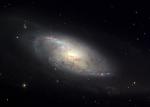 M106 in Canes Venatici
17.04.2003
Close to the Great Bear (Ursa Major) and surrounded by the stars of the Hunting Dogs (Canes Venatici), this celestial nebula was discovered in 1781 by the metric French astronomer Pierre Mechain and later added to the catalog of his friend and colleague Charles Messier as M106.
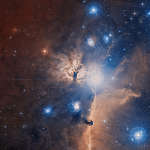 Inside the Flame Nebula
2.11.2019
The Flame Nebula stands out in this optical image of the dusty, crowded star forming regions toward Orion's belt, a mere 1,400 light-years away. X-ray data from the Chandra Observatory and infrared images from the Spitzer Space Telescope can take you inside the glowing gas and obscuring dust clouds though.
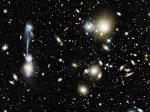 A Galactic Collision in Cluster Abell 1185
22.11.2005
What is a guitar doing in a cluster of galaxies? Colliding. Clusters of galaxies are sometimes packed so tight that the galaxies that compose them collide. A prominent example occurs on the left of the above image of the rich cluster of galaxies Abell 1185.
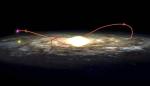 Where a Black Hole Roams
21.09.2001
Black hole candidate XTE J1118+480 is known to roam the halo of our Milky Way Galaxy. This exotic system - thought to be a stellar mass black hole consuming matter from a companion star - was discovered only last year as a flaring celestial x-ray source.
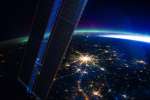 Yuri s Planet
12.04.2012
On another April 12th, in 1961, Soviet cosmonaut Yuri Alexseyevich Gagarin became the first human to see planet Earth from space. Commenting on his view from orbit he reported, "The sky is very dark; the Earth is bluish. Everything is seen very clearly". To celebrate, consider this recent image from the orbiting International Space Station.
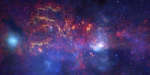 Great Observatories Explore Galactic Center
11.11.2009
Where can a telescope take you? Four hundred years ago, a telescope took Galileo to the Moon to discover craters, to Saturn to discover rings, to Jupiter to discover moons, to Venus to discover phases, and to the Sun to discover spots.
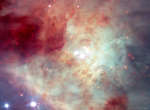 Fast Stars and Rogue Planets in the Orion Nebula
21.03.2017
Start with the constellation of Orion. Below Orion's belt is a fuzzy area known as the Great Nebula of Orion. In this nebula is a bright star cluster known as the Trapezium, marked by four bright stars near the image center.
|
January February March April May |
|||||||||||||||||||||||||||||||||||||||||||||||||