
|
You entered: background
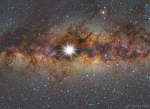 Solstice Sun and Milky Way
21.12.2021
Welcome to December's solstice, first day of winter in the north and summer for the southern hemisphere. Astronomical markers of the seasons, solstice and equinox dates are based on the Sun's place in its annual journey along the ecliptic, through planet Earth's sky.
 APOD: 2024 February 25 Б A Phoenix Aurora over Iceland
25.02.2024
All of the other aurora watchers had gone home. By 3:30 am in Iceland, on a quiet September night, much of that night's auroras had died down. Suddenly, unexpectedly, a new burst of particles streamed down from space, lighting up the Earth's atmosphere once again.
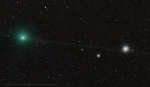 APOD: 2026 August 8 Б A Messier Moment for Tempel 2
8.08.2026
Which of these is not a comet? You guessed it - the one on the right is a globular star cluster. The diffuse greenish coma of periodic comet 10P/Tempel 2 is at left in the frame.
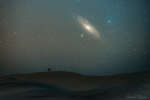 Andromeda over Patagonia
25.11.2020
How far can you see? The Andromeda Galaxy at 2.5 million light years away is the most distant object easily seen with your unaided eye. Most other apparent denizens of the night sky -- stars...
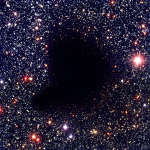 APOD: 2023 January 29 Б Barnard 68: Dark Molecular Cloud
29.01.2023
Where did all the stars go? What used to be considered a hole in the sky is now known to astronomers as a dark molecular cloud. Here, a high concentration of dust and molecular gas absorb practically all the visible light emitted from background stars.
 Comet C/2025 F2 SWAN
18.04.2025
In late March, the comet now designated C/2025 F2 SWAN was found independently by citizen scientists Vladimir Bezugly, Michael Mattiazzo, and Rob Matson while examining publicly available image data from the Solar Wind ANisotropies (SWAN) camera on the sun-staring SOHO spacecraft.
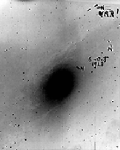 Andromeda Nebula: Var!
6.04.1996
In the 1920s, using photographic plates made with the Mt. Wilson Observatory's 100 inch telescope, Edwin Hubble determined the distance to the Andromeda Nebula - decisively demonstrating the existence of other galaxies far beyond the Milky Way.
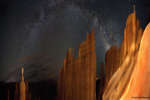 The Milky Way Over Bryce Canyon
27.07.2010
What are those strange rock structures? They are towers and walls of sedimentary rock that are particularly plentiful in Bryce Canyon in Utah, USA. The rock columns may rise higher than 50 meters and are called hoodoos. On the far left is Thor's Hammer, perhaps the most famous hoodoo.
 Milky Way Galaxy Doomed: Collision with Andromeda Pending
4.06.2012
Will our Milky Way Galaxy collide one day with its larger neighbor, the Andromeda Galaxy? Most likely, yes. Careful plotting of slight displacements of M31's stars relative to background galaxies on recent Hubble...
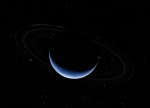 Voyager s Neptune
15.05.2014
Cruising through the outer solar system, the Voyager 2 spacecraft made its closest approach to Neptune on August 25, 1989, the only spacecraft to visit the most distant gas giant. Based on the images...
|
January February March April May June July August |
||||||||||||||||||||||||||||||||||||||||||||||||||||||||