
|
You entered: image
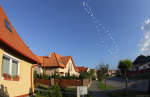 Analemma 2010
31.12.2010
Looking back on the year, have you wondered where the Sun was in the sky each day during 2010 at exacty 9am UT? Of course you have. Search no further for the answer! It was somewhere along this celestial figure 8 curve known as an analemma.
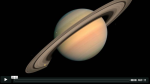 Cassini Approaches Saturn
15.03.2011
What would it look like to approach Saturn in a spaceship? One doesn't have to just imagine -- the Cassini spacecraft did just this in 2004, recording thousands of images along the way, and thousands more since entering orbit.
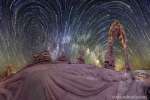 Warped Sky: Star Trails over Arches National Park
17.03.2014
What's happened to the sky? A time warp, of sorts, and a digital space warp too. The time warp occurs because this image captured in a single frame a two and a half hour exposure of the night sky. As a result, prominent star trails are visible.
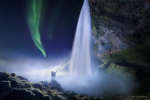 Lucid Dreaming
4.04.2016
Is this the real world? Or is it just fantasy? The truth started with a dream -- a dream that the spectacular Seljarlandsfoss waterfall in southern Iceland could be photographed with a backdrop of an aurora-filled sky. Soon after a promising space weather report, the visionary astrophotographer and his partner sprang into action.
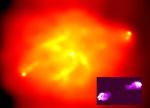 X Ray Cygnus A
5.10.2002
Amazingly detailed, this false-color x-ray image is centered on the galaxy Cygnus A. Recorded by the orbiting Chandra Observatory, Cygnus A is seen here as a spectacular high energy x-ray source. But it is actually more famous at the low energy end of the electromagnetic spectrum as one of the brightest celestial radio sources.
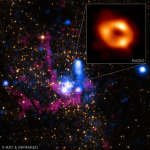 The Milky Way s Black Hole
13.05.2022
There's a black hole at the center of the Milky Way. Stars are observed to orbit a very massive and compact object there known as Sgr A* (say "sadge-ay-star"). But this just released...
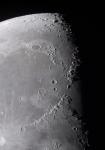 Moon Mare and Montes
28.12.2000
This arresting image of the third quarter moon in the excellent skies above the Pine Crest Farm Observatory, Dell Prairie, Wisconsin, was recorded with a 24 inch telescope and digital camera on October 19.
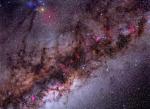 Our Galaxy in Stars, Gas, and Dust
28.09.2003
The disk of our Milky Way Galaxy is home to hot nebulae, cold dust, and billions of stars. The red nebulae visible in the above contrast-enhanced picture are primarily emission nebulae, glowing clouds of hydrogen gas heated by nearby, bright, young stars.
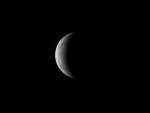 MESSENGER Approaches Mercury
16.01.2008
Two days ago, the MESSENGER spacecraft became only the second in human history to swoop past Mercury. The last spacecraft to visit the Sun's closest planet was Mariner 10 over 35 years ago. Mariner 10 was not able to photograph Mercury's entire surface, and the images it did send back raised many questions.
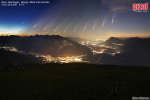 Comet NEOWISE over the Swiss Alps
15.07.2020
Comet NEOWISE has been wowing photographers around much of the world during dawn and dusk, at the margins of day and night. For the most northern residents of planet Earth, however, the comet circles the North Star and never sets.
|
January February March April May June July August September |
|||||||||||||||||||||||||||||||||||||||||||||||||