
|
You entered: full moon
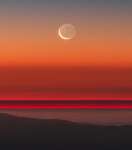 Old Moon in the New Moon s Arms
20.01.2018
Also known as the Moon's "ashen glow" or the "Old Moon in the New Moon's arms", earthshine is earthlight reflected from the Moon's night side. This stunning image of earthshine from a young crescent moon was taken from Las Campanas Observatory, Atacama Desert, Chile, planet Earth near moonset on January 18.
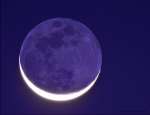 The New Moon in the Old Moon s Arms
24.03.2012
Also known as the Moon's ashen glow, Earthshine is Earthlight illuminating the Moon's night side. Taken on Nowruz, the March 20 equinox, from Esfahan, Iran, planet Earth, this telescopic image captures strong Earthshine from an old Moon. The darker earthlit disk is in the arms of a bright sunlit crescent.
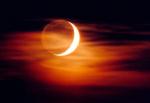 The Old Moon in the New Moon's Arms
19.04.2002
Also known as the Moon's "ashen glow" or "the old Moon in the new Moon's arms", Earthshine is Earthlight reflected from the Moon's night side. This dramatic image of Earthshine...
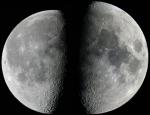 Apogee Moon, Perigee Moon
21.10.2004
Why don't these pieces fit? This third quarter Moon (left) and first quarter Moon were both photographed during the last lunar cycle or lunation with the same telescope and camera. But, simply combining the pictures into one sharp, full surface view would clearly be a problem.
 Venus On The Horizon
14.10.1997
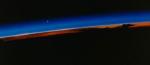
The month of October features a sky full of planets, including Venus as the brilliant evening star. Besides the sun and moon, Venus is the brightest object visible in Earth's sky. This month, Venus appears in early evening near the red planet Mars and Mars' red giant rival Antares above the southwestern horizon.
 The Big Corona
20.09.2017
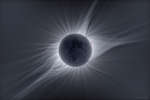
Most photographs don't adequately portray the magnificence of the Sun's corona. Seeing the corona first-hand during a total solar eclipse is unparalleled. The human eye can adapt to see coronal features and extent that average cameras usually cannot. Welcome, however, to the digital age.
 The Big Corona
1.07.2019
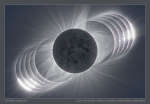
Most photographs don't adequately portray the magnificence of the Sun's corona. Seeing the corona first-hand during a total solar eclipse is unparalleled. The human eye can adapt to see coronal features and extent that average cameras usually cannot. Welcome, however, to the digital age.
 East of Antares
23.06.2006
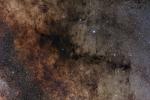
East of Antares, dark markings seem to sprawl through the crowded star fields toward the center of our Milky Way Galaxy. Cataloged in the early 20th century by astronomer E. E. Barnard, the obscuring interstellar dust clouds include B72, B77, B78, and B59, seen in silhouette against the starry background.
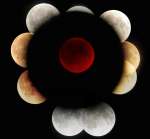 Lunar Eclipses
25.04.2013
The dark, inner shadow of planet Earth is called the umbra. Shaped like a cone extending into space, it has a circular cross section and is most easily seen during a lunar eclipse. But the complete cross section is larger than the Moon's angular size in the stages of an eclipse.
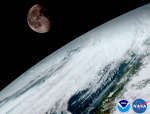 GOES 16: Moon over Planet Earth
26.01.2017
Launched last November 19 from Cape Canaveral Air Force Station, the satellite now known as GOES-16 can now observe planet Earth from a geostationary orbit 22,300 miles above the equator. Its Advanced Baseline Imager captured this contrasting view of Earth and a gibbous Moon on January 15.
|
January February March April May June July August September |
|||||||||||||||||||||||||||||||||||||||||||||||||