
|
You entered: emission nebula
 The Heart Of Orion
6.05.2000
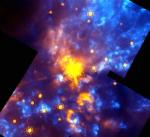
Newborn stars lie at at the heart of the the Orion Nebula, hidden from view by the dust and gas of the giant Orion Molecular Cloud number 1 (OMC-1). Sensitive to invisible infrared...
 NGC 1333: Stellar Nursery in Perseus
22.04.2023
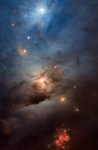
In visible light NGC 1333 is seen as a reflection nebula, dominated by bluish hues characteristic of starlight reflected by interstellar dust. A mere 1,000 light-years distant toward the heroic constellation Perseus, it lies at the edge of a large, star-forming molecular cloud.
 NGC 1333 Stardust
6.03.2014
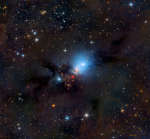
NGC 1333 is seen in visible light as a reflection nebula, dominated by bluish hues characteristic of starlight reflected by dust. A mere 1,000 light-years distant toward the heroic constellation Perseus, it lies at the edge of a large, star-forming molecular cloud.
 The Heart Of Orion
23.05.1997
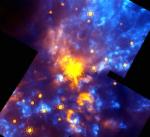
Newborn stars lie at the heart of the Orion Nebula, hidden from view by the dust and gas of the giant Orion Molecular Cloud number 1 (OMC-1). Sensitive to invisible infrared wavelengths, Hubble...
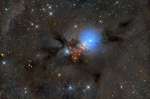 NGC 1333: Stellar Nursery in Perseus
5.11.2015
NGC 1333 is seen in visible light as a reflection nebula, dominated by bluish hues characteristic of starlight reflected by interstellar dust. A mere 1,000 light-years distant toward the heroic constellation Perseus, it lies at the edge of a large, star-forming molecular cloud.
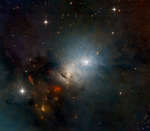 NGC 1333: Stellar Nursery in Perseus
11.11.2021
NGC 1333 is seen in visible light as a reflection nebula, dominated by bluish hues characteristic of starlight reflected by interstellar dust. A mere 1,000 light-years distant toward the heroic constellation Perseus, it lies at the edge of a large, star-forming molecular cloud.
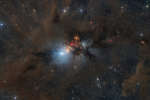 NGC 1333: Stellar Nursery in Perseus
30.01.2026
NGC 1333 is seen in visible light as a reflection nebula, dominated by bluish hues characteristic of starlight reflected by interstellar dust. A mere 1,000 light-years distant toward the heroic constellation Perseus, it lies at the edge of a large, star-forming molecular cloud.
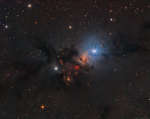 NGC 1333: Stellar Nursery in Perseus
27.03.2019
NGC 1333 is seen in visible light as a reflection nebula, dominated by bluish hues characteristic of starlight reflected by interstellar dust. A mere 1,000 light-years distant toward the heroic constellation Perseus, it lies at the edge of a large, star-forming molecular cloud.
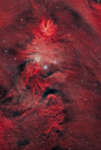 Unicorn, Fox Fur and Christmas Tree
25.12.2025
A star forming region cataloged as NGC 2264, this beautiful but complex arrangement of interstellar gas and dust is about 2,700 light-years distant in the faint but fanciful constellation Monoceros, the Unicorn. Seen...
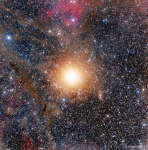 Behind Betelgeuse
11.05.2020
What's behind Betelgeuse? One of the brighter and more unusual stars in the sky, the red supergiant star Betelgeuse can be found in the direction of famous constellation Orion. Betelgeuse, however, is actually...
|
January February March April May June July August September October |
|||||||||||||||||||||||||||||||||||||||||||||||||