
|
You entered: dark cloud
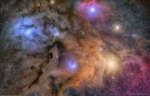 The Colorful Clouds of Rho Ophiuchi
5.07.2016
The many spectacular colors of the Rho Ophiuchi (oh'-fee-yu-kee) clouds highlight the many processes that occur there. The blue regions shine primarily by reflected light. Blue light from the star Rho Ophiuchi and nearby stars reflects more efficiently off this portion of the nebula than red light.
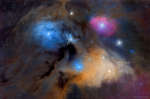 The Colorful Clouds of Rho Ophiuchi
14.10.2020
The many spectacular colors of the Rho Ophiuchi (oh'-fee-yu-kee) clouds highlight the many processes that occur there. The blue regions shine primarily by reflected light. Blue light from the Rho Ophiuchi star system and nearby stars reflects more efficiently off this portion of the nebula than red light.
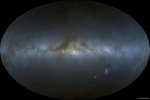 All Sky Milky Way Panorama
25.11.2009
If you could go far away from the Earth and look around the entire sky -- what would you see? Such was the goal of the All-Sky Milky Way Panorama 2.0 project of Axel Mellinger.
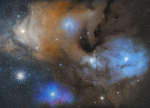 The Colorful Clouds of Rho Ophiuchi
3.12.2013
The many spectacular colors of the Rho Ophiuchi (oh'-fee-yu-kee) clouds highlight the many processes that occur there. The blue regions shine primarily by reflected light. Blue light from the star Rho Ophiuchi and nearby stars reflects more efficiently off this portion of the nebula than red light.
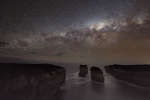 A Milky Way Shadow at Loch Ard Gorge
23.08.2010
Have you ever seen the Milky Way's glow create shadows? To do so, conditions need to be just right. First and foremost, the sky must be relatively clear of clouds so that the long band of the Milky Way's central disk can be seen.
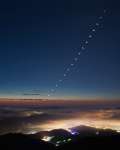 Moon Meets Morning Star
24.08.2012
Rising in the dark hours before dawn, wandering Venus now shines as the brilliant morning star. Its close conjunction with the Moon on August 13 was appreciated around planet Earth. But skygazers in eastern...
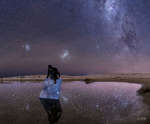 Night Sky Reflected
13.09.2021
What's that in the mirror? In the featured image of the dark southern sky, the three brightest galaxies of the night are all relatively easy to identify. Starting from the left, these are the Small Magellanic Cloud (SMC), the Large Magellanic Cloud (LMC), and part of the central band of our Milky Way Galaxy.
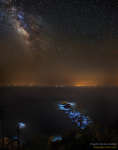 Blue Tears and the Milky Way
24.04.2015
Lapping at rocks along the shore of the Island of Nangan, Taiwan, planet Earth, waves are infused with a subtle blue light in this sea and night skyscape. Composed of a series of long exposures made on April 16 the image captures the faint glow from Noctiluca scintillans.
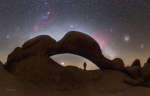 Seeking Venus under the Spitzkoppe Arch
3.11.2015
What's that in the sky? Although there was much to see in this spectacular panorama taken during the early morning hours of a day in late September, the brightest object in the sky was clearly the planet Venus.
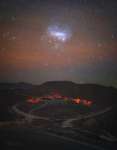 Under the Galaxy
13.10.2017
The Large Magellanic Cloud, a satellite galaxy of the Milky Way, stands above the southern horizon in this telephoto view from Las Campanas Observatory, planet Earth. In the dark September skies of the Chilean Atacama desert, the small galaxy has an impressive span of about 10 degrees or 20 Full Moons.
|
January February March April May June July August September |
|||||||||||||||||||||||||||||||||||||||||||||||||