
|
You entered: star system
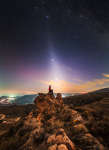 APOD: 2023 February 27 Б Zodiacal Ray with Venus and Jupiter
27.02.2023
What's causing that unusual ray of light extending from the horizon? Dust orbiting the Sun. At certain times of the year, a band of sun-reflecting dust from the inner Solar System appears prominently after sunset or before sunrise and is called zodiacal light.
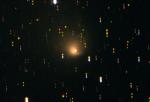 Comet Hale Bopp in the Outer Solar System
26.03.2001
Whatever became of Comet Hale-Bopp? The brightest comet in recent years has continued into the outer Solar System and is now further from the Sun than Saturn. To the surprise of many, Comet Hale-Bopp is still active, continuing to spew gas, ice and dust particles out into space.
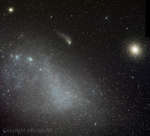 Cloud, Clusters and Comet Siding Spring
4.09.2014
On October 19th, a good place to watch Comet Siding Spring will be from Mars. Then, this inbound visitor (C/2013 A1) to the inner solar system, discovered in January 2013 by Robert McNaught at Australia's Siding Spring Observatory, will pass within 132,000 kilometers of the Red Planet.
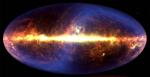 The Infrared Sky
28.01.1998
Three major sources contribute to the far-infrared sky: our Solar System, our Galaxy, and our Universe. The above image, in representative colors, is a projection of the entire infrared sky created from years of observations by the robot spacecraft COBE.
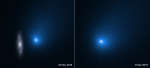 Interstellar Comet 2I Borisov
5.03.2022
From somewhere else in the Milky Way galaxy, Comet 2I/Borisov was just visiting the Solar System. Discovered by amateur astronomer Gennady Borisov on August 30, 2019, the first known interstellar comet is seen in these two Hubble Space Telescope images from November and December 2019.
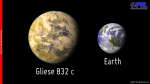 Gliese 832c: The Closest Potentially Habitable Exoplanet
9.07.2014
This planet is only 16 light years away -- could it harbor life? Recently discovered exoplanet Gliese 832c has been found in a close orbit around a star that is less bright than our Sun.
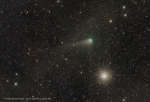 Messier 10 and Comet
21.07.2022
Imaged on July 15 2022, comet C/2017 K2 (PanSTARRS) had a Messier moment, sharing this wide telescopic field of view with globular star cluster Messier 10. Of course M10 was cataloged by 18th century comet hunter Charles Messier as the 10th object on his list of things that were definitely not comets.
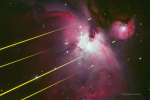 Nebula with Laser Beams
29.03.2017
Four laser beams cut across this startling image of the Orion Nebula, as seen from ESO's Paranal Observatory in the Atacama desert on planet Earth. Not part of an interstellar conflict, the lasers...
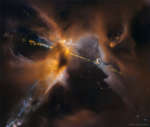 Duel Particle Beams in Herbig Haro 24
11.03.2018
This might look like a double-bladed lightsaber, but these two cosmic jets actually beam outward from a newborn star in a galaxy near you. Constructed from Hubble Space Telescope image data, the stunning scene...
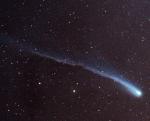 Comet Ikeya Zhang Brightens
7.03.2002
In the last week, Comet Ikeya-Zhang has become bright enough to be just visible to the unaided eye. Based on its present activity, observers are optimistic that Ikeya-Zhang will become substantially brighter. This composite...
|
January February March April May June July August September |
|||||||||||||||||||||||||||||||||||||||||||||||||